
Why Internet Actually Matters More in Indonesia

Indonesia is not a “land, walk around, and figure it out later” destination when it comes to mobile data. It is huge, spread across thousands of islands, and many of the small travel moments that look simple on paper become much easier with a working connection.
A stable Indonesia eSIM helps with:
- Airport arrival and ride-hailing: In Bali, Jakarta, Surabaya, and Medan, apps like Grab and Gojek are often the easiest way to arrange rides, compare prices, and avoid confused pickup points.
- Navigation across busy streets and island roads: Google Maps is useful in cities, but it becomes even more important when finding villas in Canggu, cafes in Ubud, homestays in Lombok, or harbors for island transfers.
- Digital bookings and mobile tickets: Hotels, ferries, day tours, airport transfers, and activity vouchers are often stored in email, WhatsApp, Klook, Agoda, Booking.com, or similar apps.
- Cashless and QR payments: Indonesia has strong digital payment habits, and while tourists should still carry cash, having data makes payment confirmations, bank checks, and app-based services smoother.
- Translation and local coordination: A few Indonesian phrases help, but live translation is a lifesaver when confirming a boat time, asking about food ingredients, or explaining a hotel address to a driver.
- Travel season pressure: During peak periods in Bali, school holidays, Eid travel season, festivals, and long weekends, transport and accommodation can move fast. Mobile data helps travelers adjust plans without relying on hotel Wi-Fi.
Public Wi-Fi can help at hotels and cafes, but it is not something to build a whole Indonesia trip around. The moment travelers need to message a driver outside the airport, check a ferry change, or find a backup route in the rain, mobile data becomes less of a nice extra and more of a travel basic.
Why Travelers Use eSIM for Indonesia Instead of Other Options
Indonesia has several ways to get online, and each one can make sense depending on the trip. The real difference is not only price. It is how much friction travelers are willing to accept after landing.
| Option | Pros | Cons | Useful case for tourists | Estimated price |
| International roaming |
|
| Short business trips, emergency backup, travelers with premium roaming included. | Often around ~US$10–12/day for day-pass style roaming. Pay-per-use roaming can be much higher depending on carrier, country, and usage. |
| Physical SIM card |
|
| Backpackers, long-stay travelers, or visitors who specifically need a local Indonesian number. | Common local/tourist SIM references are around ~US$2–12+, depending on provider, data quota, validity, promo, registration, and purchase location. |
| Pocket Wi-Fi |
|
| Families, small groups, or travelers with locked phones. | Often around ~US$3.50–14/day, depending on rental provider, data policy, deposit, shipping, and trip duration. |
| Public Wi-Fi |
|
| Backup connection for downloads, video calls, or app updates at the hotel. | Usually free, but may require venue access, login, purchase, or accept speed/session limits. |
| Travel eSIM |
|
| Most tourists, Bali travelers, city-hoppers, digital nomads, and anyone who wants data ready before landing. | Indonesia travel eSIMs commonly start from a few US dollars. Teclapi Indonesia eSIM starts from $1.17, with final price depending on duration and data package. |
For most short trips, a travel eSIM is the easiest balance: Pay online, install before flying, keep the home SIM active, and start using data when arriving in Indonesia. A physical SIM still makes sense for long stays or travelers who need a local number, while pocket Wi-Fi is better for groups with many devices.
Traveler note: Local Indonesian SIM and eSIM prices can look extremely cheap, but the full experience may include registration, quota split rules, local-language app setup, promo conditions, or payment limitations. A travel eSIM is not always the absolute cheapest route, but it is often the cleanest route for tourists who want to skip arrival friction.
What to Look for in an Indonesia eSIM Plan
App restriction note: App access may vary by Indonesia eSIM plan. Some services, including TikTok and certain AI apps such as ChatGPT, may not be supported or may not work reliably on selected Indonesia eSIM packages. For these apps, travelers may need to use hotel Wi-Fi, another mobile connection, or their home SIM if roaming is available.
An Indonesia eSIM should not be chosen only by the lowest price per GB. Indonesia’s geography makes network choice extremely important. A plan that works nicely in central Jakarta may feel very different on a beach road in Lombok or near a national park in Flores.
1. Which Mobile Network Is Best for Indonesia Travel?
| Network | Coverage | Speed | Estimated price range | Practical traveler view |
| Telkomsel | Strong national footprint. Often considered the safest choice for wide travel coverage, including Bali, Jakarta, Java, Lombok, Komodo routes, and many inter-island destinations. Publicly referenced 4G population coverage is around 97%+. | Opensignal reported Telkomsel at 35.0 Mbps Download Speed Experience in Indonesia. 5G performance is strongest in selected urban and tourist zones, not everywhere. | Carrier-direct tourist prepaid reference around ~US$8.40 for 25GB/30 days. Travel eSIM price depends on provider and plan. | Best fit for travelers who want the most practical coverage-first setup, especially for Bali plus other islands, road trips, beaches, and less predictable routes. |
| Indosat Ooredoo Hutchison / IM3 | Good urban and regional presence, with coverage check tools for 2G/4G/5G. Strong in many city and Java routes. | Opensignal reported IM3 at 23.8 Mbps Download Speed Experience nationally. IM3 also performs well in reliability and app experience metrics. | Local prepaid packages can start around ~US$2.00, with prices depending on quota, validity, promo, and purchase channel. | Good for city travel, Java routes, students, or travelers buying locally. Coverage should be checked for smaller islands or remote areas. |
| XL Axiata / XLSmart | Strong in many urban and tourist areas. XL and Smartfren are now under XLSmart, but traveler-facing plans may still appear under XL, AXIS, or Smartfren branding. | Opensignal reported XL at 28.5 Mbps Download Speed Experience nationally, making it the second-fastest in that report. | XL eSIM starter references commonly range around ~US$2.10–US$6.70, while larger data bundles cost more depending on plan. | Good for urban travelers, Bali, Java, and price-sensitive users who can manage local setup. Check exact coverage if traveling to remote beaches or islands. |
| Smartfren / XLSmart | Historically more attractive in cities and price-focused segments; post-merger coverage is improving under XLSmart. | Speed depends heavily on location and device band support. Smartfren can be good value, but it is less coverage-first than Telkomsel for broad island travel. | Tourist eSIM references include around ~US$2.50 for 5GB, ~US$8.40 for 45GB, and ~US$11.20 for unlimited 14 days with FUP. | Useful for budget travelers staying in well-covered areas, especially if they can complete local eSIM setup. Less ideal as the only connection for remote routes. |
Real signal can vary by exact location, indoor/outdoor conditions, device model, network congestion, terrain, weather, and carrier roaming agreements. For travelers moving beyond one city or one resort area, a Telkomsel-powered travel eSIM is often the most practical setup because it prioritizes coverage and consistency over chasing the lowest local price.
2. How Much Data Do You Need for Indonesia?
Indonesia is a “data sneaks up on you” destination. A short ride to a beach club, a villa check-in, a restaurant search, a ferry schedule, and a few Instagram stories can turn a light data day into something heavier than expected.
| If you're | Typical usage in Indonesia | Suggested data option | Why this fits |
| Light traveler | WhatsApp, Google Maps, hotel search, email, occasional Grab/Gojek, mostly using hotel Wi-Fi at night. |
| Good for travelers who only need data for essential apps and do not upload many photos or videos on mobile data. |
| Standard tourist | Maps, ride-hailing, restaurant search, mobile tickets, translation, WhatsApp, light social media, travel apps. |
| This gives enough room for normal daily movement in Bali, Jakarta, Yogyakarta, or Lombok without checking data usage too often. |
| Bali social traveler | Google Maps, Grab/Gojek, cafe hopping, Instagram browsing, photo uploads, short videos, beach club coordination. |
| Social media and uploads can consume data quickly, especially when travelers are moving between cafes, beaches, villas, and events. |
| Island-hopping traveler | Ferry schedules, port coordination, hotel changes, route planning, weather checks, offline map backup, WhatsApp with drivers or hosts. |
| Useful for Bali + Lombok, Komodo, Java routes, or trips with several transfers where mobile data becomes part of the travel logistics. |
| Remote worker | Hotspot, Slack/Teams, email, Google Drive, browser work, coworking backup, occasional video calls. |
| Work usage is less predictable than tourist usage. Hotspot and cloud tools can drain data quickly, so a larger plan is safer. |
| Family or group sharer | One phone shares hotspot with a partner, child, tablet, or laptop. Maps, messaging, bookings, entertainment, and occasional uploads. |
| Shared data disappears much faster than solo data, especially when another device starts syncing photos, apps, or cloud files. |
| Long-stay traveler | 15–30 days of mixed usage: maps, ride-hailing, work messages, bookings, social media, occasional hotspot. |
| Daily plans help avoid burning all data early, while larger total plans give more flexibility for uneven travel days. |
| Heavy data user | Frequent hotspot, video streaming, large uploads, long navigation sessions, cloud backup, video calls. |
| Best for travelers who do not want to calculate every upload or hotspot session, but fair-use details should still be checked before purchase. |
For most Indonesia trips, Daily 1GB or Daily 2GB is the safest starting point for normal tourists. Travelers staying mainly in Bali and using social media often should look closer at Daily 2GB, Daily 3GB, 20GB, or 30GB. For remote work, hotspot sharing, or longer stays, 50GB or Unlimited is usually the more comfortable direction.
Small buying tip: Daily plans are easier for travelers who want a fresh allowance each day, while total data plans are better for people whose usage changes from day to day. Unlimited-style plans are convenient for heavy users, but travelers should always review the plan details and fair-use conditions before checkout.
Why Choose Teclapi eSIM for Indonesia?
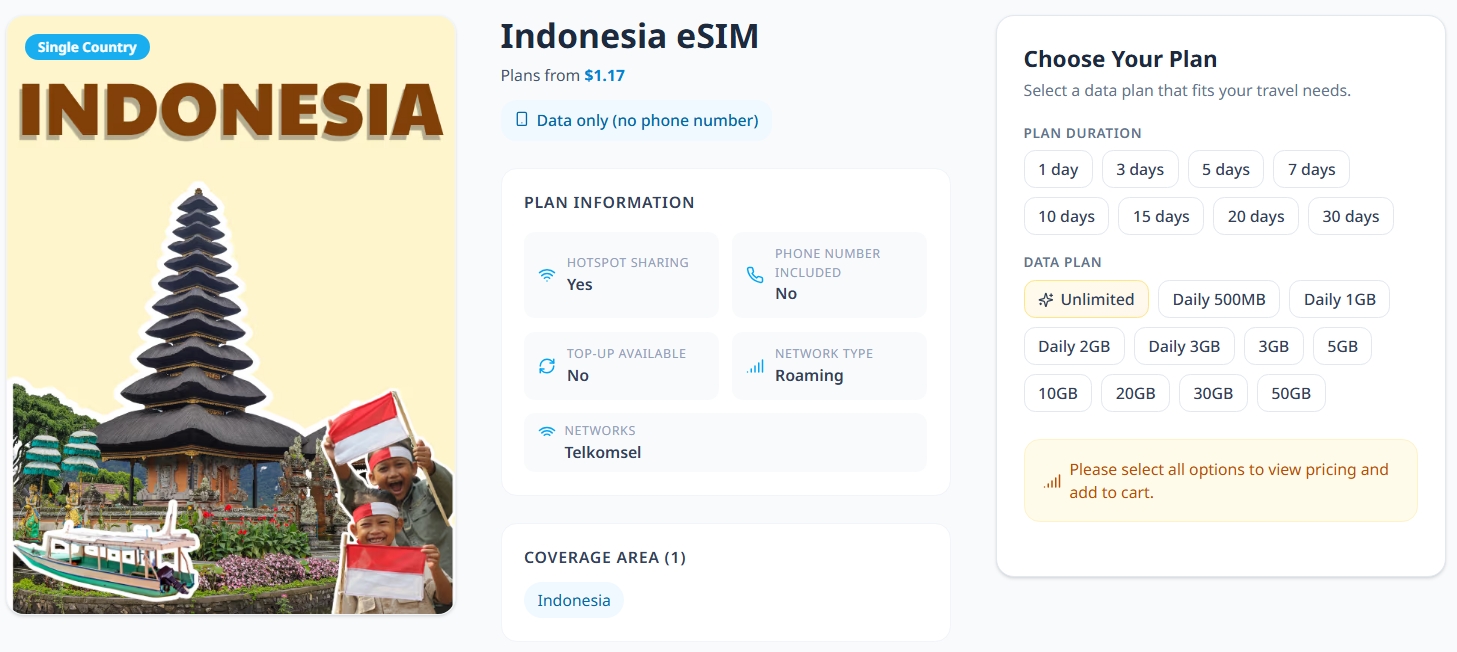
Indonesia is not just one travel style. It can be a Bali beach week, a Jakarta business trip, a Yogyakarta culture route, a Lombok surf escape, or a Komodo island adventure. Teclapi Indonesia eSIM is built for travelers who want the connection handled before the plane lands.
- Runs on Telkomsel: Teclapi Indonesia eSIM uses Telkomsel, one of Indonesia’s strongest networks for broad travel coverage.
- Asia-focused travel coverage: Indonesia sits naturally inside many Asia itineraries, and Teclapi also offers other Asia destination and regional eSIM options for multi-country trips.
- Affordable and flexible plans: Plans start from $1.17, with durations from 1 to 30 days and daily, total, and unlimited-style data options.
- QR code delivered by email: After payment, the eSIM QR code is sent by email, so travelers can install it before departure.
- No contracts, no hidden roaming bill: The plan is prepaid, so travelers can choose what they need without a roaming surprise after the trip.
- Hotspot supported: Useful for sharing data with a laptop, tablet, or travel companion.
- Keep the home SIM active: Use the Indonesia eSIM for data while keeping the primary SIM available for OTP, banking alerts, and important calls.
- Traveler-friendly support: Teclapi support is available through WhatsApp, Zalo, Facebook, and email, which is helpful when activation questions appear at the least romantic time possible - usually right after landing.
Teclapi is especially suitable for travelers who value a smooth arrival more than hunting for the absolute cheapest local SIM. For Indonesia, the Telkomsel network choice is the main advantage because it matches how people actually travel: From airports to city streets, then beaches, temples, islands, and road trips.

Conclusion
For most tourists, the best eSIM for Indonesia is not simply the cheapest plan. It is the plan that gives reliable local coverage, enough data for real travel behavior, and a setup that does not steal time from the trip. A Telkomsel-powered option like Teclapi Indonesia eSIM is a practical fit for Bali, Jakarta, Yogyakarta, Lombok, and wider Indonesia routes, especially for travelers who want to land ready for maps, ride-hailing, WhatsApp, and bookings. Choose the data size that matches the trip, check device compatibility before ordering, and let the airport SIM queue become someone else’s travel story.