
Getting internet in China is not difficult, but it is different. You may land in Beijing with full bars and still wonder why Google Maps refuses to cooperate, why WhatsApp will not load, or why the airport WiFi wants a phone number you do not have. The good news is that travelers have several reliable ways to stay connected in China — local SIM cards, travel eSIMs, pocket WiFi, international roaming, and public WiFi — as long as you understand what each option does well, and where it becomes a tiny travel puzzle.
How Good Is the Internet in China?

China has strong mobile and broadband infrastructure, especially in major cities. According to the Speedtest Global Index by Ookla, China’s March 2026 median mobile download speed was about 156.98 Mbps, placing it around #26 globally, while fixed broadband reached about 206.91 Mbps, around #35 globally. For travelers, that means cities like Beijing, Shanghai, Guangzhou, Shenzhen, Chengdu, Xi’an, Hangzhou, and Chongqing usually offer fast 4G/5G coverage. Rural mountain areas, desert regions, and some scenic zones can still be more uneven, so a strong carrier network matters if your China itinerary goes beyond the biggest cities.
The bigger issue for tourists is not always speed — it is access. Mainland China’s internet filtering system, often called the Great Firewall, blocks or restricts many services that travelers normally use every day, including Google, WhatsApp, Instagram, Facebook, YouTube, and several other foreign platforms. That affects how you navigate, message, translate, store tickets, and share trip photos. Your data may be fast, but without the right setup, the apps you actually need may still sit there spinning like they are meditating.
1. Which Local Carriers are the Fastest in China?
China’s three main mobile networks all cover the country well, but they are not identical. The best choice depends on where you are traveling, what device you use, and whether you care more about city speed, rural coverage, or tourist convenience.
| Network provider | Network type | Estimated population coverage | Average mobile speed | Tourist destination coverage | Best use case |
| China Mobile | 4G LTE / 5G / 5G-A in many major cities | Around 99% 4G, around 96% 5G | Around 131 Mbps average download in reported benchmark comparisons | Very strong in major cities, airports, high-speed rail corridors, county towns, and many rural areas | Best overall choice for travelers who want broad coverage across classic city + nature itineraries |
| China Telecom | 4G LTE / 5G, with shared 5G infrastructure in many areas | Around 98% 4G, around 94% 5G in reported comparisons | Around 118 Mbps average download in reported benchmark comparisons | Strong in eastern and southern China, good in cities and many business districts | Good for travelers staying mostly in developed urban areas or southern/eastern provinces |
| China Unicom | 4G LTE / 5G, with shared 5G infrastructure in many areas | Around 96–99% 4G depending on source, around 94% 5G in reported comparisons | Around 113 Mbps average download in reported comparisons | Good in major cities and transport hubs; often considered friendly for international device compatibility | Good for city-focused travelers and visitors using unlocked international phones |
For most tourists, China Mobile is the safest network bet when the itinerary mixes big cities with day trips, scenic areas, or long train routes. That is one reason Teclapi’s China eSIM uses China Mobile networks: it gives travelers a strong foundation before they start worrying about more interesting things, like whether they ordered “slightly spicy” or “local spicy.”
2. What Should I Know About Free WiFi in China?
Free WiFi is available in many places, but it should be treated as a backup rather than your main connection plan. It can help in the right moment, yet it comes with a few China-specific catches that surprise first-time visitors.
- Where you can find it: hotels, airports, shopping malls, coffee shops, some restaurants, train stations, and selected metro stations in large cities.
- The common problem: many public WiFi networks require SMS verification, often with a Chinese phone number. If you only have a foreign number or a data-only eSIM, access may not always work.
- The access issue: public WiFi is usually still subject to the same internet restrictions as local networks, so blocked apps may remain blocked.
- The security concern: avoid logging into banking, business systems, or sensitive accounts on unknown public WiFi unless you are using a trusted VPN or secure connection.
- The practical workaround: some travel eSIM providers include routing or built-in VPN-style access for China, but you should check the plan details before purchase because this varies by provider.
Public WiFi can rescue you when you need to message your hotel or load a booking confirmation, but relying on it for your entire trip is risky. In China, your “free WiFi plan” can quickly become a “please send SMS to a number I do not have” plan.
What Are the Best Ways to Get Internet in China for Tourists?
China rewards travelers who plan connectivity before arrival. Once you are standing in an airport arrivals hall with luggage, jet lag, and a taxi driver waiting, the most convenient option is usually the one you prepared yesterday.
| Option | Setup | Price | Data speed | Convenience | Hotspot/tethering | Keep home number | Best for |
| Travel eSIM for China | Buy online, receive QR code, install before departure, activate on arrival | Usually affordable, varies by provider and plan | Usually 4G/5G, depending on network and plan | ★★★★★ | Often supported, check plan terms | Yes, your physical SIM can stay in your phone | Most tourists, short trips, multi-city travel, travelers who want internet ready on landing |
| Local physical SIM card | Buy at airport kiosk or carrier store; passport registration usually required | Often good value for longer stays | Strong 4G/5G on local networks | ★★★☆☆ | Usually supported | No, unless your phone supports dual SIM | Longer stays, travelers who need a Chinese phone number for local services |
| Pocket WiFi rental | Reserve online or rent at airport; carry and charge a separate device | Can be cost-effective for groups | Good in covered areas, depends on device and network | ★★★☆☆ | Yes, built for sharing | Yes | Families, groups, travelers with several devices |
| International roaming | Enable roaming with your home carrier before travel | Usually the most expensive | Can be good, but depends on roaming partner and fair-use limits | ★★★★☆ | Sometimes restricted | Yes | Business travelers, very short trips, people who prefer one bill |
| Public WiFi | Connect where available; may require SMS verification | Free | Varies widely | ★★☆☆☆ | No | Yes | Backup only, hotel use, quick browsing |
All four paid options can work, but the best choice for most modern travelers is now a China eSIM. It avoids the airport SIM queue, keeps your home SIM active for banking OTPs and messages, and gives you mobile data as soon as your phone connects to the local network. The key is to choose a China eSIM that clearly states the network, data allowance, hotspot policy, validity period, and whether it helps with access to blocked apps.
Traveler tip: For a short sightseeing trip, choose a daily data plan if you like predictable usage. For a longer trip or mixed usage, a total-data plan is usually easier to manage. If you plan to stream, work remotely, use hotspot, or travel with children who believe cartoons are a human right, consider a larger or unlimited option.
Is Teclapi eSIM China Worth it for your trip?
eSIM Note: Before buying any eSIM, please check that your phone supports eSIM and is carrier-unlocked. Many recent iPhone, Samsung Galaxy, Google Pixel, and selected Huawei/Oppo models support eSIM, but compatibility varies by model, country version, and carrier lock status.
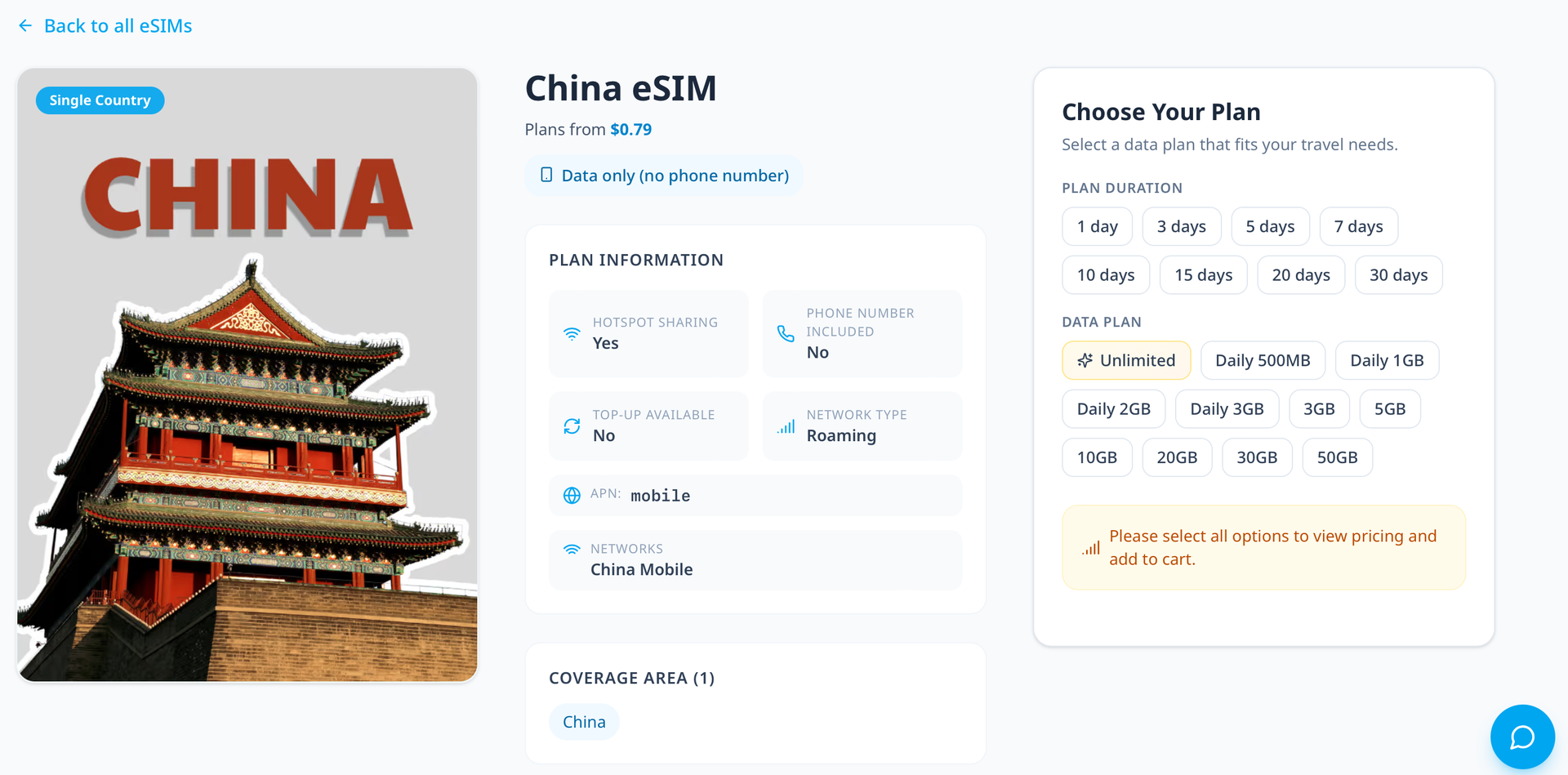
Buying a local SIM card in China can work well, but it usually means in-person passport registration, possible queues at airport kiosks, and staff who may not always speak English. A travel eSIM sidesteps most of that: you can buy it before departure, install it on WiFi, and arrive with your data plan ready to connect.
For China trips, Teclapi’s China eSIM is positioned for travelers who want a practical setup rather than a telecom research project.
- Runs on China Mobile networks, a strong choice for broad tourist coverage across cities, transport routes, and many regional areas.
- Plans from just $0.79, depending on the selected package and currency at checkout.
- China included in Teclapi’s Asia coverage, useful if your trip also includes nearby destinations.
- QR code delivery by email after payment, so you can install before boarding.
- Support available through WhatsApp, Zalo, Facebook, and email, which is helpful when you are setting up before departure.
- Good fit for tourists who do not need a Chinese phone number, but want mobile data for maps, ride-hailing, translation, messaging, and browsing.
Teclapi is not the only way to get online in China, and travelers who need a local Chinese number may still prefer a physical SIM. But for visitors who mainly need reliable travel data without airport paperwork, a China eSIM is often the cleaner option.

How Much Data Do I Need for A China Trip?
Buying too little data can turn every map search into a budgeting exercise. Buying too much is also wasteful, especially if your hotel WiFi is decent. The right amount depends on how you travel: a museum-and-tea-house traveler uses far less data than someone uploading 4K food videos from every dumpling shop in Shanghai.
| Traveler type | Typical daily usage | 7-day trip estimate | Best-fit Teclapi plan style |
| Light user | 300MB–700MB/day: Messaging, email, hotel booking checks, light maps | 3GB–5GB | Small total-data plan or low daily plan |
| Average traveler | 1GB–2GB/day: Maps, translation, social apps, ride-hailing, browsing, short videos | 7GB–14GB | Daily 1GB–2GB plan or 10GB–15GB total plan |
| Heavy user | 3GB–5GB/day: Frequent video, cloud photo backup, hotspot for laptop, long map use | 21GB–35GB | Larger total-data plan or high daily plan |
| Digital nomad | 5GB+/day: Video calls, hotspot, file sync, work apps, streaming after work | 35GB+ | Unlimited or high-cap total-data plan |
China adds a few extra data considerations. Google Maps is blocked on normal local internet, so many travelers rely on Baidu Maps, AMAP, Apple Maps, hotel addresses, and screenshots. VPN use or VPN-style routing can also add overhead, commonly around 10–15%, because your traffic takes a less direct path. That means a traveler who normally uses 1GB per day abroad may want to budget closer to 1.2GB per day in China.
Offline maps tip: Download offline areas and save hotel addresses before leaving your hotel WiFi. For China, also screenshot addresses in Chinese characters, because showing “No. 88 Some Lovely Road” to a taxi driver is less helpful than showing the actual Chinese address.
What Are Teclapi Trip Tips for Staying Connected in China?

A good data plan is only one part of staying connected in China. A few small steps before departure can save a surprising amount of time once you land.
- Download your VPN before boarding. VPN provider websites and app downloads may be blocked or difficult to access inside China, so install and test your VPN at home if you plan to use one.
- Install and register WeChat before your trip. WeChat is widely used for messaging, local communication, mini-programs, bookings, and sometimes payments. Registration can be easier before arrival when you still have stable access to your usual phone number and app store.
- Screenshot your hotel address in Chinese characters. Save your hotel name, address, phone number, and nearest metro station in Chinese. This helps with taxis, ride-hailing, and asking for directions.
- Download offline maps before leaving city areas. AMAP and Baidu Maps are useful in China, while Apple Maps can also work for many travelers. Save key destinations before long train rides, mountain visits, or countryside day trips.
- Turn off Google app auto-sync. If Google services are blocked, some apps may keep trying to sync in the background, quietly using data and battery without giving you anything useful in return.
- Keep your home SIM active for banking OTPs. If your phone supports dual SIM, use the China eSIM for data and keep your home number available for verification messages.
- Carry a power bank. China travel often involves long walking days, QR codes, translation apps, and map use. Your phone is not just a phone there; it is your ticket wallet, phrasebook, navigator, camera, and occasionally your emotional support rectangle.
For seasonal travel, prepare extra carefully around Chinese public holidays such as Lunar New Year and Golden Week. Airports, train stations, scenic areas, and mobile networks can all become busier than usual, and “I will figure it out when I arrive” becomes a less charming strategy.
So, What is The Easiest Way to Stay Connected in China?
China has fast networks, wide 4G/5G coverage, and plenty of ways to get online, but tourists need to plan around app restrictions, SMS verification, and local SIM registration. For most short trips, a China eSIM offers the best balance of speed, convenience, and control: install before you fly, keep your home number available, and land with mobile data ready. If you want a simple option built around China Mobile coverage, explore Teclapi’s China eSIM plans before your trip.