
The best eSIM for Thailand is the one that keeps you online in the moments that actually matter: When you land in Bangkok and need your hotel address, when your Grab driver messages in Thai, when Google Maps decides the alley behind the night market is somehow the correct route, or when you need to confirm a ferry, tour, restaurant booking, or airport transfer. Thailand is a very connected country, but for travelers, “there is internet somewhere nearby” is not the same as “I can use data right now.” A good Thailand eSIM should be easy to install before departure, work on reliable local mobile networks, include enough data for your travel style, support hotspot if needed, and ideally give you support when your phone settings choose chaos.
Why Does Internet Actually Matter More in Thailand?

Thailand looks easy to travel in, and in many ways, it is. The food is everywhere, the beaches are photogenic without trying, and there is usually a café, mall, hotel lobby, or station nearby. But the small gap between “I should be fine” and “I have no signal, no Thai, and my driver is calling me” is where travel internet becomes less of a nice extra and more of a survival tool.
Reliable mobile data matters in Thailand because:
- Bangkok's transit system rewards live data: The BTS Skytrain, MRT, and river ferries are far easier to navigate with a live app than a printed map, especially when a station closure or platform change happens with zero English signage.
- Tourist season turns public Wi-Fi into a shared, slow resource: During peak months, a café Wi-Fi network meant for twenty people is suddenly serving two hundred — and your hotel confirmation email is not loading fast enough to be useful.
- Cashless payment is everywhere, and it needs a connection to work: From 7-Eleven to street-food stalls now running QR payments, a dead connection at checkout is its own special kind of stress.
- Translation apps do real work here: English signage thins out fast once you're past the main tourist strip, and a translation app only helps if it's actually online.
- Island and ferry schedules change without warning: A delayed boat to Koh Phangan or a last-minute hotel swap in Krabi is a non-event with working data — and a genuine headache without it.
- Roaming and public Wi-Fi each solve only half the problem: Roaming is reliable but often brutally priced; public Wi-Fi is free but inconsistent exactly when you need it most.
None of this means Thailand is hard to travel in — it isn't. It means the version of Thailand most people picture (smooth Grab rides, instant translations, zero stress at checkout) depends on a phone that's actually online, not one that's hoping for the nearest hotspot.
Why Travelers Use eSIM for Thailand Instead of Other Options

Before settling on a Thailand travel eSIM, it's worth seeing exactly how it stacks up against the other three realistic ways to get online here, in Thailand. None of them is the "wrong" choice in every situation — but the trade-offs are different enough that it's worth a proper look rather than a guess.
| Option | Setup effort | Typical cost | Keeps home number active | Best for |
| eSIM | Install before you fly, activate on arrival | Low–moderate | Yes | Most tourists, short-to-mid trips |
| Local physical SIM | Buy + register with passport after landing | Low | Yes (in second slot) | Longer stays (3+ weeks), budget travelers comfortable queuing |
| International roaming | None — works automatically | High | Yes (it is your number) | Travelers who need zero setup and don't mind paying for it |
| Pocket Wi-Fi router | Rent or buy, carry and charge separately | Moderate | Yes | Groups or families sharing one connection across devices |
The reason eSIM has become the default choice for so many Thailand-bound travelers isn't complicated: It removes the single most annoying arrival-day task. Instead of landing jet-lagged and hunting for a SIM counter, you install the eSIM at home on your own Wi-Fi, and it's simply on the moment your plane touches down.
Traveler note: A quietly important update worth knowing — keep the physical SIM active for calls and SMS while the eSIM handles data only, meaning you don't lose your home number for the trip; you just add a second, data-focused line. If you're booking your eSIM in advance, double-check if eSIM is supported on your specific phone model, since a small number of older or region-locked devices only support one active line at a time.
What to Look for in a Thailand eSIM Plan
1. The Network Behind Your eSIM
For Thailand, the network behind your eSIM matters because travelers rarely stay in one neat city center. A normal trip can move from Bangkok airport to hotel check-in, then to night markets, temples, shopping malls, beach towns, ferry piers, and island cafés. Your Thailand eSIM needs to work across that real travel pattern — not just in a perfect speed-test location.
Thailand’s main mobile networks are AIS, TrueMove H, and DTAC. Teclapi Thailand eSIM runs on True and DTAC, giving travelers practical network flexibility in popular destinations such as Bangkok, Phuket, Chiang Mai, Pattaya, Krabi, Koh Samui, and other major travel areas.
| Network | Coverage & tourist destinations | Speed benchmark | Traveler takeaway |
| AIS | Opensignal rated AIS highest for Coverage Experience at 8.5/10, with 99.4% availability. Strong benchmark for Bangkok, Chiang Mai, northern routes, intercity travel, and mixed itineraries. | Speedtest Speed Score: 70.60. Opensignal average download speed: 30.2 Mbps. | Strong overall benchmark network in Thailand, especially for travelers moving across several regions. |
| True / TrueMove H | True states its network reaches 99% of Thailand’s population on 4G and 94% on 5G. Practical for Bangkok, Suvarnabhumi, Don Mueang, Phuket, Pattaya, Chiang Mai, Krabi, Koh Samui, shopping malls, beach towns, and major tourist routes. | Speedtest Speed Score: 68.55. Opensignal average download speed: 31.2 Mbps. | Strong default network for most tourists using maps, Grab, hotel apps, social media, messaging, and hotspot. |
| DTAC | Opensignal rated DTAC at 7.4/10 Coverage Experience with 99.5% availability. DTAC and TrueMove H share network infrastructure after the merger, making DTAC useful across many of the same tourist zones. | Speedtest Speed Score: 63.99. Opensignal average download speed: 31.3 Mbps. | Useful alternative when signal feels weaker indoors, near ferry piers, around islands, in hotels, or crowded tourist spots. |
For a Thailand travel eSIM, the strongest setup is not only about choosing a network with good benchmark results. It is also about having enough flexibility for real travel conditions. Bangkok airport, a hotel room in Sukhumvit, a beach café in Phuket, a ferry pier in Krabi, and a night market in Chiang Mai can all behave differently, even on the same network.
That is why Teclapi Thailand eSIM running on True and DTAC is useful for travelers. True works well as a default option across major tourist areas, while DTAC gives extra flexibility when signal quality changes indoors, near coastal routes, around islands, or in crowded places. Instead of depending on public Wi-Fi, travelers can stay connected through established local mobile networks throughout most of the trip.
Network note: True and DTAC merged in 2023 and now operate under True Corporation, although travelers may still see both names appear in eSIM settings or network references.
2. Sizing Your Data Plan to How You'll Actually Travel
Travelers most often get this wrong by overbuying "just in case" or underbuying because a 1GB plan looked cheap on the page. A better approach starts with what you're actually doing with your phone each day, rather than a generic number pulled from nowhere.
| Travel style | Typical behavior | Suggested data range | Best fit |
| Light traveler | Maps, messaging, hotel bookings, light browsing | 1–2GB per day | Short city trips or Wi-Fi-heavy travelers |
| Standard tourist | Maps, Grab, social media, translation, photo uploads | 2–4GB per day | Most Thailand trips |
| Content-heavy traveler | Reels, video uploads, cloud backups, frequent navigation | 4–6GB per day | Creators and heavy social users |
| Remote worker / hotspot user | Laptop hotspot, video calls, file sharing, online meetings | 6GB+ per day or unlimited | Workation, digital nomads, group sharing |
| Island-hopping traveler | Maps, ferry updates, hotel transfers, travel apps | 3–5GB per day | Phuket, Krabi, Koh Samui, Koh Tao, Koh Phangan |
For a relaxed Thailand holiday, a standard tourist should avoid buying the smallest package unless the trip is very short. If you expect to use hotspot, upload videos, navigate daily, or rely on mobile data outside hotels, an unlimited data eSIM Thailand plan is usually more comfortable.
3. Sharing the Connection from eSIM
Hotspot and tethering matter more than most travelers expect until the moment someone in the group needs a laptop online and there's no café in sight. A Thailand eSIM with hotspot sharing lets you turn your phone into a personal Wi-Fi point for a travel companion's phone, a tablet, or a laptop — genuinely useful for couples, families, and anyone doing a bit of remote work between beach days. One catch worth checking before you buy: some "unlimited" plans quietly cap hotspot data separately from the main allowance, so it's worth confirming this isn't buried in fine print.
Why I Should Choose Teclapi eSIM for Thailand
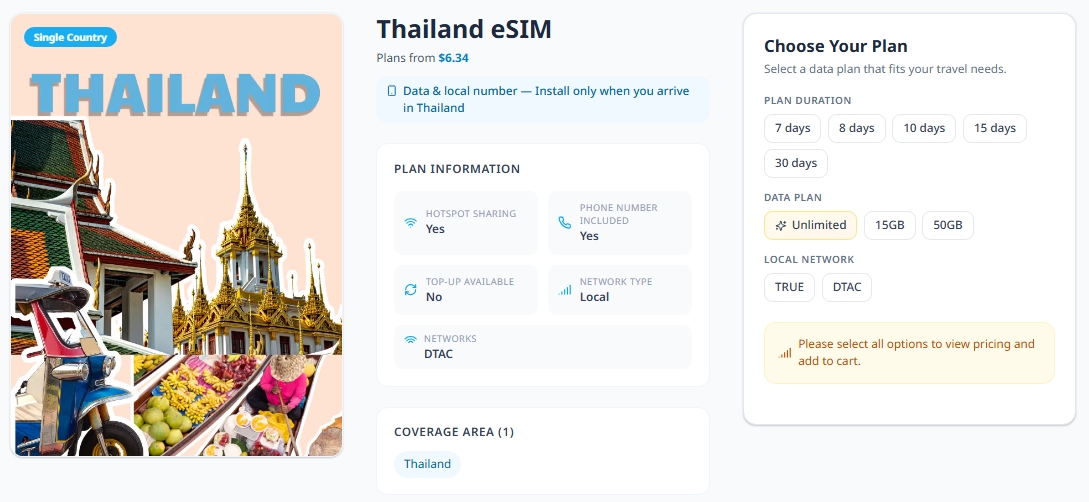
Runs on DTAC & TRUE networks: Teclapi Thailand eSIM connects through established Thai mobile networks, making it a practical choice for popular destinations such as Bangkok, Phuket, Chiang Mai, Pattaya, Krabi, Koh Samui, and other key tourist areas.
Includes a real Thai phone number: Unlike many data-only travel eSIMs, Teclapi Thailand eSIM comes with an actual Thai number, which is useful for calling hotels, tour operators, restaurants, drivers, and local services.
Supports unlimited calls and SMS to Thai networks: Travelers do not have to rely only on internet calling apps when they need to contact local businesses, confirm bookings, or handle travel changes during the trip.
Offers affordable and flexible plans: With plans from just $6, travelers can choose a package that fits their trip length and data needs, without contracts or hidden fees.
Recommends unlimited data for Thailand travel: For travelers using maps, Grab, social media, translation, video calls, hotspot, and daily travel apps, an unlimited plan helps remove the stress of checking data every few hours.
Fits multi-country Asia travel behavior: Thailand is often part of a wider Asia itinerary, combined with destinations such as Vietnam, Singapore, Malaysia, Japan, South Korea, or Bali. Teclapi’s Asia-focused coverage makes regional travel connectivity easier to plan.
Delivers the QR code by email: After payment confirmation, travelers receive the eSIM QR code by email, so they can install it before departure and get ready before landing in Thailand.
Allows hotspot sharing: Travelers can share data with family, friends, or another device, which is useful for couples, families, remote workers, and anyone carrying both a phone and a laptop.
Provides traveler-friendly support: Teclapi offers support through WhatsApp, Zalo, Facebook, and email, helping travelers handle setup questions, APN settings, QR code issues, or roaming-related confusion more easily.
For travelers who want a Thailand eSIM that is more than just a silent data package, Teclapi is a strong fit: local network access, a Thai phone number, unlimited call/SMS support, hotspot sharing, and setup before arrival.

Ready to Choose the Best eSIM for Thailand?
So, what is the best eSIM for Thailand? It is the one that fits the way you actually travel: enough data for maps and apps, reliable local network access, hotspot when needed, simple QR setup, and support if something goes sideways. For travelers who want more than a data-only plan, Teclapi Thailand eSIM is a practical choice with DTAC & TRUE network access, a real Thai phone number, unlimited calls and SMS to Thai networks, flexible plans from $6, and QR code delivery by email. Choose your Thailand eSIM before you fly, install it on Wi-Fi, and arrive ready to move — not ready to queue.