
Thailand is one of those places where your phone becomes part travel guide, part translator, part restaurant hunter, and part emergency “where is my Grab driver?” device. From landing at Bangkok Suvarnabhumi Airport to finding your hotel in Chiang Mai or checking ferry times in Koh Samui, having reliable internet in Thailand can save you time, money, and a surprising amount of sweaty confusion.
How Good Is the Internet in Thailand?

Thailand is generally a very connected country for travelers. According to Speedtest Global Index data for March 2026, Thailand recorded a median mobile download speed of about 137.98 Mbps, placing it among the stronger mobile internet markets in Asia.
In real travel terms, Bangkok, Chiang Mai, Phuket, Pattaya, Krabi, Koh Samui, and other major tourist areas usually have strong 4G and expanding 5G coverage. Rural mountain areas, remote islands, jungle routes, national parks, and long ferry journeys can still have weaker signal, so Thailand is not “full bars everywhere,” but it is very comfortable for most tourist itineraries. That brings us to the question many travelers actually care about: which Thai carrier should you trust?
1. Which Local Carriers Are the Fastest in Thailand?
Thailand has three main mobile brands travelers will usually see: AIS, DTAC, and TrueMove H. One important local detail: True and DTAC have merged under True Corporation, and parts of their network infrastructure are now shared, which is why their performance can be close in many places.
Here is a practical comparison:
| Carrier | Network type | Coverage / availability | Average speed | Tourist destination coverage | Best use case |
| AIS | 4G / 5G | Overall availability around 99.4%; strongest coverage experience score among the three | Overall download: 30.2 Mbps; 5G download: 105.3 Mbps | Very strong in Bangkok, Chiang Mai, Phuket, major islands, and many regional areas | Travelers who want the strongest 5G performance and wider coverage confidence |
| DTAC | 4G / 5G | Overall availability around 99.5%; shares infrastructure with True after the merger | Overall download: 31.3 Mbps; 5G download: 90.1 Mbps | Good in major tourist areas, cities, beaches, and common travel routes | Travelers who want solid everyday speed, video streaming, and good city/island usability |
| TrueMove H | 4G / 5G | Overall availability around 99.4%; shares infrastructure with DTAC after the merger | Overall download: 31.2 Mbps; 5G download: 84.3 Mbps | Strong in Bangkok, Pattaya, Phuket, shopping districts, airports, and tourist zones | Travelers staying mostly in urban areas and popular holiday destinations |
The numbers show a useful pattern: AIS is the 5G leader, while DTAC and True are very competitive for normal tourist use. If your trip is mostly Bangkok, Chiang Mai, Phuket, Pattaya, Krabi, or Koh Samui, all three can work well; if you are going more remote, coverage matters more than peak speed.
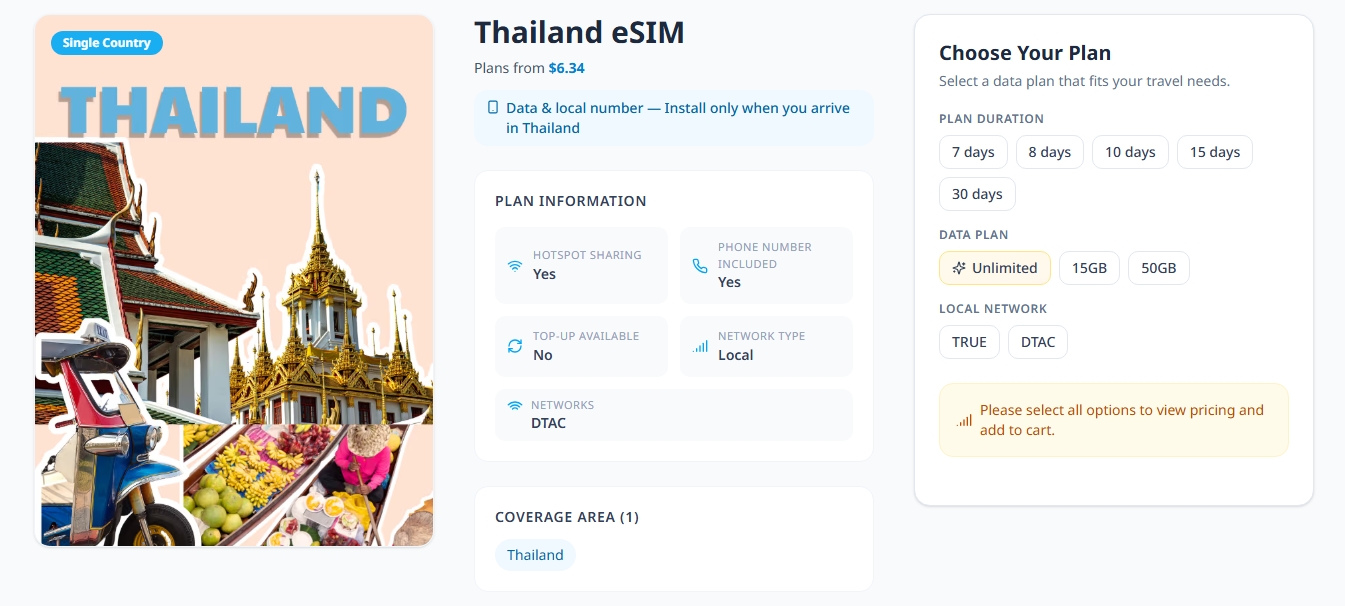
Traveler tip: Teclapi’s Thailand eSIM includes a local Thai phone number and shows TRUE / DTAC network options on the product page, which is useful for calling hotels, tour operators, restaurants, or drivers inside Thailand. For many visitors, that local number is more practical than a data-only travel eSIM.
2. Free WiFi in Thailand - What Should I Expect?
Free WiFi is easy to find in Thailand, but it is better treated as a backup than your main internet plan. It is helpful when you are sitting down with an iced Thai tea, less helpful when your taxi is waiting on the wrong side of the road.
You can usually find free WiFi in:
- Hotels and hostels — usually good enough for browsing, messaging, and light video calls, but quality varies by room location.
- Cafes and restaurants — common in Bangkok, Chiang Mai, Phuket, and tourist towns; you may need to ask staff for the password.
- Airports — available at major airports, but speed and login limits can vary.
- Shopping malls — often available in places like Siam Paragon, CentralWorld, Terminal 21, and large malls in tourist cities.
- Some metro stations and public areas — useful occasionally, but not reliable enough for daily navigation.
The downside is that public WiFi may require registration, can be crowded, and is not ideal for banking, booking changes, or anything sensitive. If you rely on free WiFi in Thailand, use a VPN for private tasks and always keep offline access to your hotel address, passport copy, and travel documents.
What Are the Best Ways to Get Internet in Thailand for Tourists?
Thailand gives travelers several ways to stay connected, and each one makes sense for a different kind of trip. The best choice depends on whether you care most about price, convenience, speed, keeping your home number, or avoiding the airport SIM counter when everyone from your flight has the same idea.
| Option | Setup | Price | Data speed | Convenience | Hotspot / tethering | Keep home number | Best for |
| Travel eSIM | Buy online, receive QR code by email, install before or when you arrive | Usually affordable; Teclapi Thailand eSIM currently starts from $5.32 | 4G / 5G depending on plan, phone, and location | ★★★★★ | Usually yes, check plan details | Yes, your physical SIM can stay in your phone | Most tourists, couples, business travelers, repeat Thailand visitors |
| Local physical SIM card | Buy at airport, mall, 7-Eleven, or carrier store; passport registration usually required | Often cheap, especially for local tourist SIM bundles | Usually fast on AIS, DTAC, or True | ★★★☆☆ | Usually yes | No, unless your phone supports dual SIM | Budget travelers who do not mind registration and SIM swapping |
| Pocket WiFi | Rent online or at airport; carry and recharge a separate device | Moderate to expensive for solo travelers, better for groups | Usually good in cities and tourist routes | ★★★☆☆ | Yes, designed for multiple devices | Yes | Families or groups sharing one connection |
| International roaming | Turn on roaming from your home carrier | Can be expensive unless your plan includes Thailand | Depends on roaming partner | ★★☆☆☆ | Sometimes limited | Yes | Short business trips or travelers with a strong roaming package |
For most tourists, a best Thailand eSIM is now the easiest balance of convenience, price, and control. You can set it up before departure, keep your home number active for WhatsApp or OTPs, and avoid starting your trip by comparing SIM packages under airport lighting after a long flight.
Tip for choosing the right Thailand eSIM: Pick based on itinerary, not just price. A short Bangkok city break may only need a small total-data plan, while a 10-day trip across Bangkok, Chiang Mai, Phuket, and island tours is safer with a larger total-data or unlimited plan. If you need to call hotels, restaurants, or tour operators, choose a plan with a local Thai phone number, not just data.
Is Teclapi eSIM for Thailand Worth It for Your Trip?
Before buying any eSIM, check whether your phone is eSIM-compatible and carrier-unlocked. Most recent iPhones, Google Pixel models, and many Samsung Galaxy devices support eSIM, but some regional versions do not. Checking this before departure saves you from becoming a detective at the airport.
Buying a physical SIM card in Thailand is not hard, but it is still a process: airport kiosks can have queues, passport registration is required for tourist SIMs, and not every counter experience is smooth in English. A Thailand eSIM sidesteps most of that. You can install the plan by scanning a QR code and keep your original SIM in the phone, so your normal number stays available while your travel data runs through the eSIM.
Teclapi’s Thailand eSIM is built for travelers who want more than “just data”:
- Local Thai phone number included — useful for calling hotels, tour operators, restaurants, clinics, and drivers.
- TRUE / DTAC network options shown on the product page — practical for popular routes across Bangkok, Chiang Mai, Phuket, Pattaya, Krabi, Koh Samui, and beyond.
- Plans from $6 — current product-page pricing, suitable for different trip lengths.
- Hotspot sharing supported — helpful when traveling with a partner, laptop, or second device.
- QR code sent by email after payment — install before departure or when you have stable WiFi.
- Traveler support available — WhatsApp, Zalo, Facebook, and email support if setup does not go as planned.
The biggest advantage for Thailand is the local number. Many eSIMs are data-only, which is fine until you need to call a hotel front desk, confirm a diving tour, or explain to a driver that you are standing outside the wrong 7-Eleven. It happens. Thailand has many 7-Elevens.

How Much Data Do I Need for Thailand Trip?
Buying too little data can turn every Google Maps search into a tiny budgeting decision. Buying too much is not a disaster, but it is money that could have gone toward mango sticky rice, which is a serious travel category in Thailand.
| Daily usage | 7-day trip estimate | Recommended Teclapi-style option | |
| Light user | 300MB–700MB/day | 2GB–5GB | Small total-data plan if available, or a low daily plan |
| Average traveler | 1GB–2GB/day | 7GB–14GB | 15GB total plan or daily plan |
| Heavy user | 3GB–5GB/day | 21GB–35GB | 50GB total plan |
| Digital nomad | 5GB+/day | 35GB+ | Unlimited plan or 50GB+ depending on work habits |
Thailand-specific usage tends to be higher than travelers expect because many daily actions are app-based: Grab rides, Google Maps, LINE or WhatsApp calls, translation apps, restaurant searches, mobile tickets, Klook bookings, Agoda or Booking.com changes, and short-form video while waiting for trains, ferries, or friends who are “five minutes away.”
Data drains fastest when you use YouTube, TikTok, Instagram Reels, Netflix, cloud backup, video calls, mobile hotspot for a laptop, and constant map navigation with satellite view. Data barely moves when you use text messaging, email, basic web browsing, ride-hailing, hotel booking apps, or Google Maps after you have downloaded offline areas.
Offline maps tip: Before flying, download offline maps for Bangkok, Chiang Mai, Phuket, and any island or road-trip area on your itinerary. Offline maps will not replace live traffic completely, but they reduce data use and help when signal gets weaker on ferries, mountain roads, or remote beaches.
Teclapi Trip: Tips for Staying Connected in Thailand

A little preparation makes Thailand much easier to navigate, especially when your day can jump from temple visits to night markets to a boat transfer faster than your phone battery would like.
- Install your eSIM while on stable WiFi. Do it at home before departure or at your hotel, not while balancing luggage at the airport.
- Turn on data roaming for the eSIM line only. Travel eSIMs often need roaming enabled to connect to partner networks, while your home SIM can stay off for roaming data.
- Keep your home SIM active for calls and OTPs, but disable its mobile data. This helps you receive bank codes or WhatsApp messages without triggering expensive roaming.
- Download Grab, Google Maps, LINE, WhatsApp, Agoda, Klook, and your airline app before you go. These apps are especially useful in Thailand, where transport, bookings, and local communication often happen through mobile apps.
- Save your hotel address in Thai. This is useful for taxi drivers, delivery riders, and moments when pronunciation decides to take a holiday.
- Carry a small power bank. Hot weather, maps, photos, and ride-hailing can drain your battery quickly, especially in Bangkok, Phuket, and Chiang Mai day trips.
- Be realistic on islands and national parks. Koh Tao, Koh Phangan, Phi Phi, Khao Sok, and remote beaches can have weaker signal in certain pockets, even on good networks.
So, What Is the Best Internet Option in Thailand?
Thailand is an easy country to stay connected in, but the best option depends on how you travel. Free WiFi is useful but limited, roaming is simple but often expensive, pocket WiFi works well for groups, and local SIM cards are cheap but require in-person registration. For most modern travelers, a Thailand eSIM offers the cleanest balance: quick setup, reliable 4G/5G access, hotspot support, and the ability to keep your home number active. If you also want a local Thai phone number for calls and bookings, Teclapi’s Thailand eSIM is worth checking before your trip.
Flying to Thailand soon? Set up your eSIM before departure, keep your home number active, and arrive with data plus a Thai number ready for the little local moments that make travel easier.