
Finding the best eSIM for China is less about chasing the biggest data number and more about choosing a plan that works when the trip gets real: Scanning a metro QR code in Shanghai, translating a menu in Chengdu, calling a DiDi outside Beijing South Railway Station, checking train updates on 12306, or finding the right gate when everyone around you seems to know exactly where they are going. China is incredibly connected, but it is also a place where travel depends heavily on mobile-first services. A good China eSIM gives you data before you start improvising with airport Wi-Fi, roaming fees, or a SIM counter queue after a long flight.
Why Does Internet Actually Matter More in China?

China is one of those destinations where mobile data quietly becomes part of almost every travel decision. It is not just for scrolling, posting, or checking the weather. It helps you move, pay, translate, verify, navigate, and recover quickly when plans change.
- Payments often happen on the phone. Alipay and WeChat Pay are widely used across restaurants, shops, taxis, convenience stores, scenic spots, and transport services. Even though foreign bank cards and cash are becoming easier to use, mobile payment remains the most natural way to move through daily life in China.
- Transport is app-heavy. High-speed rail tickets, metro routes, ride-hailing, airport transfers, and city navigation often involve apps, QR codes, real-time updates, or digital confirmations. When a train platform changes or your driver messages in Chinese, mobile data suddenly feels less optional.
- Translation is not a nice-to-have. English is common in some hotels and major tourist areas, but not everywhere. Menus, signs, taxi conversations, attraction rules, and small local shops often become much easier when your translation app is ready.
- China’s travel seasons can be intense. During major holidays such as Spring Festival and Golden Week, stations, airports, attractions, and hotels can become extremely busy. Reliable data helps with queue changes, ticket checks, map rerouting, and last-minute plan adjustments.
- Public Wi-Fi is not always the easy backup. Some Wi-Fi networks may require a local phone number, identity verification, or a login flow that is difficult to complete when you have just landed. It may also be slow or unstable in crowded places.
- Some foreign websites and apps may not work normally. Travelers who rely on Google services, WhatsApp, Instagram, Gmail, or other international apps should prepare before arrival and check their connectivity setup carefully.
China rewards travelers who prepare the small digital details before the trip. Once data is working, the rest of the experience feels more manageable: maps load, payments go through, messages arrive, and the country becomes much easier to explore.
Why Do Travelers Use eSIM for China Instead of Other Options?

China gives travelers several ways to get online, but each option has a different level of effort. The best choice depends on how long you stay, how much data you need, and how much you want to deal with after landing. For many short-term tourists, eSIM has become the most practical option because it can be bought before departure, installed on a compatible phone, and activated when the trip begins.
| Internet option in China | Setup | Typical cost | Data speed | Convenience | Hotspot/tethering | Keep home number | Best for |
| Travel eSIM | Buy online, scan QR code, activate on arrival | Usually flexible by data and duration | Usually 4G/5G where available | ★★★★★ | Often supported, depending on plan | Yes | Tourists who want data ready before landing |
| Local physical SIM card | Buy at airport or carrier store, usually with passport registration | Often affordable locally | Strong local network access | ★★★ | Usually supported | Not always, unless dual SIM is available | Longer stays or travelers who need a Chinese phone number |
| International roaming | Turn on roaming with home carrier | Often expensive | Depends on roaming partner and package | ★★★★ | Depends on home carrier | Yes | Business travelers with company-paid roaming |
| Pocket Wi-Fi | Reserve or rent, carry another device | Can be good for groups | Depends on device and network | ★★★ | Yes | Yes | Families or groups sharing one connection |
| Public Wi-Fi | Find and log in where available | Free or low cost | Unstable in crowded areas | ★★ | No | Yes | Emergency backup, not a main travel |
Important note about apps in China: A China eSIM helps you stay connected for travel essentials such as maps, translation, browsing, mobile payments, ride-hailing, email, and hotel or itinerary updates. However, internet access in mainland China is different from many other destinations. Some international apps and platforms, including TikTok, ChatGPT and other AI tools, Google services, Instagram, WhatsApp, YouTube, X, and Facebook, may not work normally or may be unavailable due to local internet restrictions. Travelers who rely on these apps should prepare alternatives before arrival and avoid assuming that any China eSIM will automatically unlock restricted services.
What Should You Look for in a China eSIM Plan?
A China eSIM should be judged by how it supports the actual trip, not only by the headline data allowance. A plan that looks cheap but runs out too quickly, does not support hotspot, or has unclear activation instructions can become expensive in time, stress, and missed turns.
1. Network that the eSIM Use in China
China has three major mobile network operators: China Mobile, China Unicom, and China Telecom. All three are strong in major cities, but the difference becomes more important when your itinerary includes scenic areas, long rail routes, smaller cities, or day trips outside the urban core.
| Network | Key coverage numbers | Top tourist destinations covered | Speed | Best for |
| China Mobile | 2.77M+ 5G base stations; continuous coverage from township level and above | Beijing, Shanghai, Xi’an, Chengdu, Guangzhou, Shenzhen, Hangzhou, Suzhou, Guilin, Zhangjiajie, popular Great Wall areas | China national mobile median: 164.94 Mbps. Strong enough for daily browsing, maps, translation, ride-hailing, mobile payments, video calls, and light hotspot use in covered areas. | Travelers who want broad coverage for city + train + tourist routes |
| China Unicom | 4.7M+ 4G/5G base stations | Beijing, Shanghai, Guangzhou, Shenzhen, Chengdu, Hangzhou, Nanjing, Suzhou, major business districts | China national mobile median: 164.94 Mbps. Suitable for app-based city travel, web browsing, navigation, messaging, and payment apps in major urban areas. | Travelers staying mostly in large cities |
| China Telecom | 1.54M+ 5G mid/high-band base stations; strong urban network footprint | Airports, railway stations, hotels, commercial areas, major city routes | China national mobile median: 164.94 Mbps. Good for daily travel apps, hotel check-ins, itinerary updates, maps, and work communication in city areas. | Travelers who mainly need stable city-based connectivity |
For most tourists, the safest choice is not simply “the fastest network on paper”, but the eSIM provider that clearly states the local network, supports the traveler’s device, offers the right data size, and gives clear activation instructions.
Teclapi China eSIM runs on China Mobile networks, it is a practical fit for travelers who want broad destination coverage across China’s major cities, train routes, and popular tourist areas.
2. Data Volume for A China Trip
Data needs in China can rise quickly because travelers use the phone for more than entertainment. Maps, translation, ride-hailing, payment apps, attraction research, messaging, and video calls can all add up, especially when public Wi-Fi is not reliable.
| Traveler type | Daily behavior | Suggested data direction |
| Light traveler | Messaging, maps, occasional browsing, hotel Wi-Fi at night | 1GB/day can work for short trips |
| Standard tourist | Maps, translation, payments, social apps, daily searches, ride-hailing | 2–3GB/day is more comfortable |
| Heavy user | Video calls, social posting, hotspot, remote work, frequent navigation | 3GB+/day or unlimited plan is safer |
| Family or group hotspot user | Sharing data with another phone, tablet, or laptop | Choose a larger total plan or unlimited plan with hotspot support |
A simple rule works well: if your China itinerary is mostly city sightseeing with hotel Wi-Fi at night, a daily or total data plan may be enough. If you plan to use hotspot, upload videos, take long train rides, work remotely, or travel during peak season, an unlimited or larger data plan removes a lot of mental math.
3. Hotspot & Tethering
Hotspot support is useful in China because one phone often becomes the group’s small travel router. It helps when a travel partner’s data fails, when a laptop needs a connection, or when a tablet is being used for maps, bookings, or work.
Always check hotspot terms before buying. Some unlimited plans reduce speed after a fair-use threshold, and some providers limit tethering even when the data allowance looks generous.
Why Should You Choose Teclapi eSIM for China?
Before you order: Please check the eSIM-compatible device list and make sure your phone is unlocked. eSIM installation requires a compatible device, and the QR code cannot be used on phones that do not support eSIM.
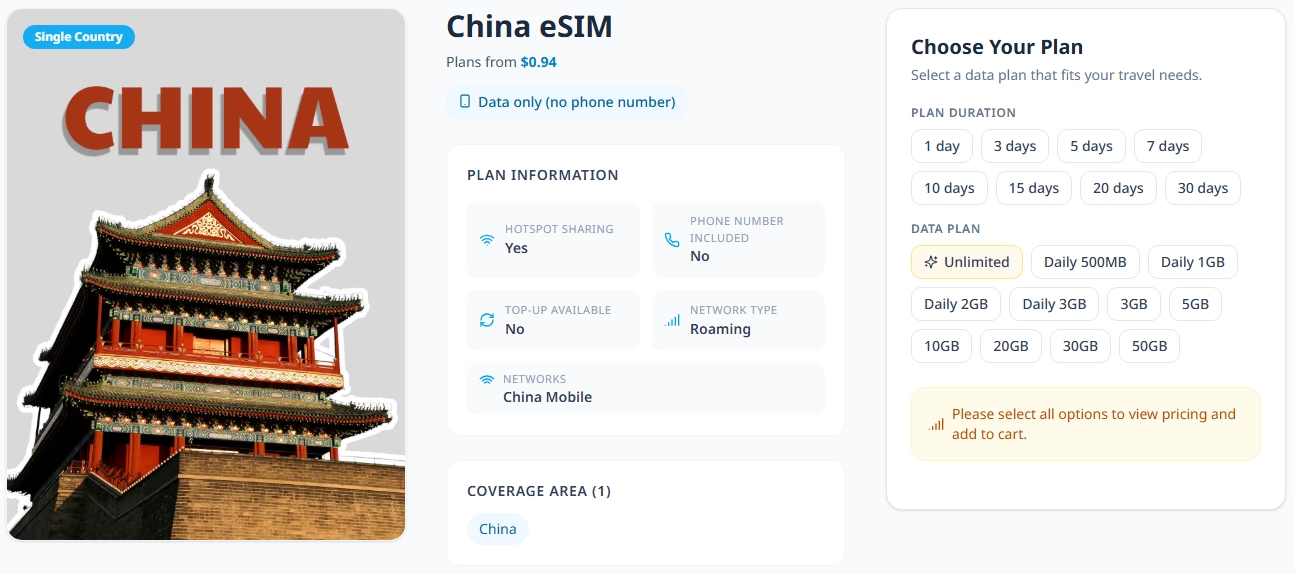
China is not a destination where travelers want to "figure out the internet later." The moment you land, you may need maps, payment apps, hotel details, translation, ride-hailing, and train information. Teclapi China eSIM is built around that practical travel moment: get the data setup ready before arrival, then use your phone like a travel tool from the first airport sign onward.
- Runs on China Mobile — the broadest-coverage choice for mixed itineraries. Among China's three carriers, China Mobile is generally the strongest pick for travelers who move between major cities, transport corridors, and tourist areas rather than staying in one place, which is why it's the network Teclapi uses for its China plans.
- Plans start at $0.94 — among the most accessible entry prices for a short, light-use China trip, without locking you into a package larger than you need. Heavier users and longer stays can step up to bigger Total or Unlimited plans instead of buying multiple small ones.
- Daily, Total, and Unlimited plan options, from 1 to 30 days. A light traveler passing through for a few days can keep costs low; a heavier user planning a multi-city trip can choose a larger or unlimited option. (Fair-use note: as with other "unlimited" eSIM plans in the category, full-speed data is typically capped per day before speeds step down — check the plan page for the current threshold before you buy, especially if you're planning to hotspot or stream.)
- Data-only, by design. Teclapi China eSIM is built for the things that drain a traveler's data — maps, browsing, messaging, translation, ride-hailing, email — not for replacing your home number. If a Chinese phone number is essential for SMS verification or local services, pair it with a local SIM rather than expecting the eSIM to cover that.
- No contracts, no hidden fees. You buy what the trip needs and nothing recurs after that — no roaming-bill surprises once you're home.
- QR code sent by email after payment, so setup happens before you fly. Install while you still have stable home Wi-Fi, keep your physical SIM active for calls and SMS, and switch on the eSIM data line once you land — which matters in China specifically, since installing an international eSIM after you've already entered the country isn't reliably possible.
- Support through WhatsApp, Zalo, Facebook, and email — channels that work for "my flight just landed and I need this fixed now," rather than a ticket queue.
Teclapi is a good fit for travelers who want a China eSIM that is simple, affordable, and built around real travel behavior: payment apps, train routes, hotel check-ins, translation, and daily navigation. It keeps the setup light so the trip can be about China, not about your phone settings.

Conclusion: Is a China eSIM Worth It?
A China eSIM is worth it for travelers who want internet ready before the trip begins, especially in a country where maps, mobile payment, translation, transport apps, and real-time updates shape the travel experience. Local SIM cards and roaming still have their place, but for most short-term visitors, eSIM is the cleaner choice: install before departure, activate on arrival, and spend less time negotiating with Wi-Fi screens. For a simple China-ready option, choose a Teclapi China eSIM plan that matches your itinerary and data habits before you fly.