
Why Does Internet Actually Matter More in Vietnam?

Vietnam is easy to love — the food, the coastline, the chaos of a busy Old Quarter street at 7am — but it rewards travelers who are connected in a way that not every country does. A few specifics that go beyond the generic "maps and messaging" advice:
Vietnamese addresses can be genuinely confusing. Street numbers often use a slash format, such as 12/3 Nguyen Trai, which means building 12, entrance 3 — and that entrance might be down a narrow alley. Google Maps handles these well; asking a hotel receptionist to draw you a map less so.
Grab is the backbone of urban transport. Ho Chi Minh City and Hanoi have almost no metered taxi infrastructure that tourists can reliably flag down. Grab is how most travelers and locals move around both cities, which means a working data connection is not optional — it is how you get home after dinner.
Translation fills real gaps. English is widely spoken in tourist-heavy areas, but menus at local pho shops, bus route signs, and small guesthouse notice boards are almost entirely in Vietnamese. Google Translate's camera function can read a printed menu in real time, which occasionally prevents you from accidentally ordering something adventurous.
Cashless payments are expanding faster than most travelers expect. QR code payments via MoMo, VNPay, and Zalo Pay are increasingly common at markets, small cafés, and street food stalls. Even if you use cash for most things, you will likely encounter at least one booking confirmation or entrance ticket that requires scanning a QR code online.
Domestic transport runs on messaging. Train bookings through the Vietnam Railways app, bus companies that send WhatsApp updates, guesthouses that confirm check-in via Zalo rather than email — staying reachable in Vietnam often means staying online.
Festival and event travel amplifies everything. During DIFF 2026 in Da Nang, tens of thousands of people converge on the Han River waterfront on competition nights. Finding your group, booking a Grab home after the show, and checking the next night's schedule all require mobile data — and public Wi-Fi in a crowd of that density is not a realistic fallback.
Public Wi-Fi in hotels and cafés can supplement your data plan, but it should not replace it. Many public networks in Vietnam require a local phone number for SMS login, locking out tourists who have not yet found a SIM card. A Vietnam travel eSIM installed before departure means your data is working before you have even cleared customs.
Why Do Travelers Use eSIM for Vietnam Instead of Other Options?

Travelers have several ways to get internet in Vietnam, including: International roaming, public Wi-Fi, a local physical SIM, pocket Wi-Fi, or a Vietnam eSIM. Each option can work, but the best choice depends on how much convenience, flexibility, and control you want before arrival.
Option | Setup | Cost (1 week, ~5GB) | Speed | Keep home number | Hotspot | Best for |
International Roaming | None — it just works | $30–$80+ | 4G/5G (carrier-dependent) | Yes | Usually yes | Short trips, emergencies |
Local SIM (physical) | Airport kiosk / shop, passport required | $5–$12 | 4G/5G local speed | No | Yes | Long stays, budget travelers |
Pocket Wi-Fi / MiFi | Rental counter at airport | $5–$10/day rental | 4G shared | No | Yes (shared device) | Groups, multi-device |
Travel eSIM | Install before departure, activate on arrival | $6–$20 | 4G/5G (network-dependent) | Yes (dual SIM) | Yes | Most international tourists |
Travel eSIMs sit in a sweet spot: You install them at home before you board, activate them the moment you land, and your data is live without any queuing or bureaucracy. Most modern smartphones support dual SIM, which means you keep your home number active for calls and texts while your eSIM handles all the data. For most international visitors to Vietnam in 2026, this combination of simplicity, speed, and flexibility makes eSIM the default smart choice.
Vietnam supports eSIM technology across all three major carriers - Viettel, Vinaphone, and Mobifone. Your travel eSIM will access one of these networks depending on your provider's roaming agreements. Viettel has the widest rural coverage, which matters if your itinerary takes you beyond the major cities.
Traveler note: If your phone is carrier-locked or does not support eSIM, a travel eSIM will not work. Check device compatibility before buying, especially if you use an older phone or bought it through a mobile carrier contract.
What Should I Look for in a Vietnam eSIM Plan?
Choosing a Vietnam eSIM is not only about picking the plan with the biggest data allowance. The right option depends on where you are going, how your phone supports eSIM, and how much you rely on mobile data each day. A traveler navigating Da Nang during DIFF 2026, sharing videos and booking rides after the fireworks, will naturally need a different setup from someone spending five relaxed days exploring Hanoi’s food scene.
1. Which Vietnam Networks Should I Care About?
Vietnam has strong mobile coverage in major travel areas, especially in cities and popular destinations. For travelers, network quality matters most in places like airports, city centers, beaches, train stations, mountain towns, and festival zones.
When choosing a Vietnam eSIM, look for plans that connect through established local networks such as Viettel, Vinaphone, MobiFone, or other supported Vietnam network partners. Viettel is often strong for broad coverage, while Vinaphone and MobiFone are also widely used in urban and tourist areas. Your exact experience can still vary by location, building, weather, congestion, and the plan’s network configuration.
Carrier | Coverage Strength | 5G Cities | Rural/Mountain Coverage | Best for |
Viettel | Strongest nationwide | Hanoi, HCMC, Da Nang | Best of the three | All itineraries, including Ha Giang, Sapa, Mekong |
Vinaphone | Strong in cities | Hanoi, HCMC | Moderate | City-heavy trips |
Mobifone | Good in cities and coasts | Hanoi, HCMC, Da Nang | Limited | Beach destinations |
If your trip involves Ha Giang, Sapa, Phong Nha, or anywhere off the well-worn tourist trail, check that your eSIM provider connects to Viettel. For city-to-city travelers sticking to Hanoi, Ho Chi Minh City, Da Nang, and Hoi An, any of the three will work perfectly well.
2. How Much Data Do I Need in Vietnam?
Overspending on data you won't use is almost as frustrating as running out halfway through the trip. The table below maps common traveler types to realistic daily usage and a seven-day estimate, giving you a sensible starting point rather than a guess:
If you're | Typical Daily Use | 7-Day Estimate | 10-Day Estimate | Recommended Plan |
Light user (maps + messaging) | ~100–200 MB | ~1–1.5 GB | ~1.5–2 GB | 3 GB plan |
Average traveler (maps, social, video calls) | ~300–600 MB | ~2–4 GB | ~4–6 GB | 5–7 GB plan |
Heavy user (streaming, hotspot, work) | ~800 MB–2 GB | ~6–14 GB | ~10–20 GB | 15–20 GB or unlimited |
Digital nomad (remote work, video, uploads) | ~2–5 GB | ~14–35 GB | ~20–50 GB | Unlimited plan |
Keep in mind that Vietnam-specific apps add to your data budget in ways travelers sometimes don't anticipate. Grab (the ride-hailing app) runs more or less continuously in the background when you're navigating a city. Zalo (Vietnam's most popular messaging platform) is worth installing if you're booking guesthouses or communicating with local tour operators — it's lighter than WhatsApp but still uses data. If you plan to stay in touch with home via video call during the evenings, add roughly 250–400 MB per hour of FaceTime or WhatsApp video.
3. Do I Need a Vietnam eSIM with a Local Number?
Many Vietnam eSIM plans are data-only, which is fine for WhatsApp, Messenger, FaceTime, Telegram, Google Maps, Grab, and browser-based bookings. However, some travelers may prefer a Vietnam eSIM with a local phone number if they need to receive local calls, register for certain services, or communicate with drivers and hotels more easily.
So, the choice is simple, a data-only Vietnam eSIM works well for app-based communication and everyday travel data, while a Vietnam eSIM with a phone number is better if you expect to make or receive local calls, use SMS, or communicate more directly with local services.
Why Should I Choose Teclapi eSIM for Vietnam?
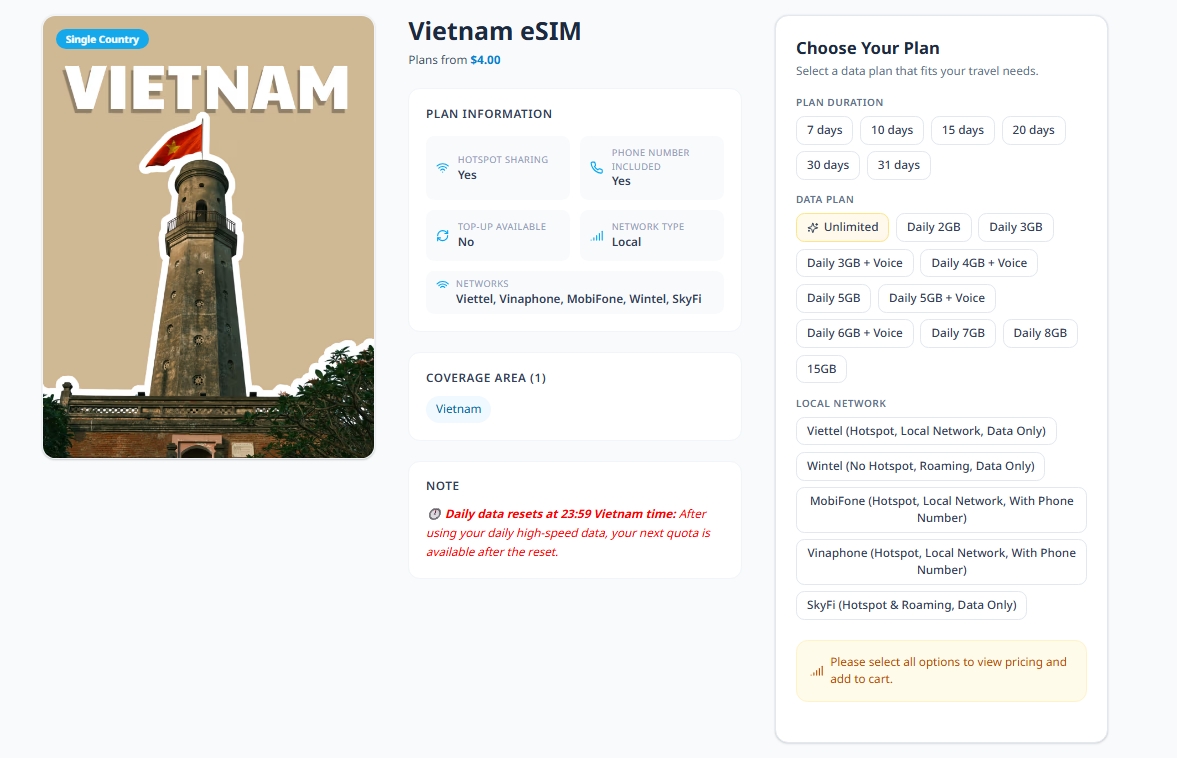
Vietnam is not just another destination on a list for Teclapi. It is one of the places where local travel behavior really matters: Grab pickups, hotel addresses, QR tickets, Zalo messages, Google Maps, flight updates, and sudden “let’s go to Hoi An tonight” plans all depend on mobile data working when the traveler needs it.
With Teclapi Vietnam eSIM, travelers can choose a plan that fits the trip instead of forcing the trip to fit the SIM card.
- Built for Vietnam travel routes: Teclapi Vietnam eSIM plans are designed for common tourist routes such as Hanoi, Ho Chi Minh City, Da Nang, Hoi An, Nha Trang, Sapa, Ha Long Bay, and Phu Quoc.
- Local Vietnam network access: Depending on the selected plan, Teclapi supports Vietnam network options such as Viettel, Vinaphone, MobiFone, Wintel, and SkyFi, helping travelers choose a setup that matches their needs.
- Flexible plan styles: Travelers can choose between daily data, total data, unlimited-style options, and selected plans with a Vietnamese phone number, depending on availability at checkout.
- No physical SIM swap: Install by QR code, keep your home SIM in place, and avoid losing a tiny SIM card somewhere between passport control and your hotel.
- Useful for real travel apps: Use Google Maps, Grab, WhatsApp, Messenger, Zalo, Booking.com, Agoda, Klook, airline apps, and translation tools with mobile data.
- Hotspot options on selected plans: Helpful for laptops, tablets, family travel, or remote work days from a café.
- Support when needed: Teclapi provides traveler support via WhatsApp, Zalo, Facebook, and email, which is especially useful if you run into setup questions before or during the trip.
The best reason to choose Teclapi is not only the QR code. It is the way the Vietnam eSIM is shaped around how travelers actually move through Vietnam: Landing, booking rides, checking maps, visiting multiple cities, joining events, and staying reachable without paying roaming fees.

Heading to DIFF 2026? Here's How to Stay Connected in Da Nang

If your Vietnam trip this summer coincides with the Da Nang International Fireworks Festival, commonly known as DIFF 2026 — then connectivity deserves extra thought. DIFF 2026 runs from May 30 to July 11, 2026, transforming the Han River waterfront into one of Southeast Asia's most spectacular summer events. Ten teams from nine countries compete across six themed competition nights, with fireworks launched every Saturday evening from 8:00 PM.
What does this mean for your data plan? Quite a bit, actually. On competition nights, the area around Tran Hung Dao Street and the Han River grandstand fills with tens of thousands of visitors — local networks can get congested during peak hours. This makes having a dedicated data plan (rather than relying on public Wi-Fi) genuinely important for navigating crowd management, finding your group, and sharing those spectacular fireworks photos before the data blackout that happens when everyone around you tries to do the same thing.
A few practical notes for DIFF 2026 travelers specifically:
Book your eSIM before you arrive in Da Nang: During festival weekends, airport kiosks and local phone shops near the festival venue can be extremely busy. Installing a Teclapi eSIM before departure sidesteps all of that completely.
Download the DIFF 2026 official app or map before the show night: Crowd navigation around the Han River is much easier with cached maps. Use data during quieter daytime hours to download offline maps of central Da Nang.
Use Grab to pre-book your return ride: After the show ends, surge pricing and driver availability both get unpredictable. Booking your ride home via Grab during the final 15 minutes of the display — while you still have a strong connection — saves a lot of post-show frustration.
Check the DIFF schedule for your competition night: The six competition nights run on specific themes — Nature (May 30), Heritage (June 6), Culture (June 13), Creativity (June 20), Vision (June 27), and the Grand Final (July 11). Planning your stay around a particular country's performance is worth doing in advance.
Da Nang is easy to enjoy, but festival nights need a little more planning. If you are visiting for DIFF 2026, look beyond the fireworks schedule and think about how you will move around before and after the show. Our Da Nang International Fireworks Festival travel guide covers viewing areas, timing, and practical tips for staying connected when the riverside gets busy.
Have A Good Trip!
Vietnam is a country where good mobile data quietly makes every travel day easier, from airport pickup to street-food discovery, from train updates to fireworks nights in Da Nang. A Vietnam eSIM is not the only way to get online, but for many travelers it is the most convenient balance of preparation, flexibility, and peace of mind. Planning your route from Hanoi to Ho Chi Minh City, or heading to Da Nang for DIFF 2026, pick a Teclapi Vietnam eSIM before you fly, install it on Wi-Fi, and let your first job in Vietnam be choosing what to eat — not finding a SIM counter.