
Choosing the best eSIM for Japan is not just about finding cheap mobile data. It is about making your trip feel easier from the moment you land. Japan is beautiful, organized, and incredibly rewarding to explore, but it is also a place where your phone quietly becomes your travel assistant: train guide, translator, map, restaurant finder, ticket holder, and “wait, which exit are we supposed to take?” problem-solver. A good Japan eSIM helps you stay connected from the airport to the last train of the day, without relying on patchy public Wi-Fi or spending your first hour in Japan comparing SIM card counters.
Why Does Internet Actually Matter More in Japan?

Some destinations let you get away with being a little offline. You can wander around, point at menus, follow the crowd, and somehow everything works out.
Japan is not quite like that.
That is not a bad thing. In fact, it is part of what makes Japan so impressive. The country runs on precision, timing, and tiny details. Trains arrive on time, restaurants may be hidden on the third floor of a narrow building, and the best local spots are not always the ones with big English signs outside. Having mobile data does not just make your Japan trip more convenient; it helps the whole trip flow better.
Here is where internet access becomes genuinely useful:
- The train system is amazing, but it can be a lot on your first day. Tokyo alone has JR lines, Tokyo Metro, Toei Subway, private railways, airport trains, and more station exits than anyone should have to process after a long flight. Google Maps or Apple Maps can guide you through platform numbers, transfer times, train types, and walking routes, but only when your phone is connected.
- A wrong train can change your whole morning. In Japan, the difference between a local, rapid, limited express, and Shinkansen route matters. Real-time data helps you check which train to board, whether your route has changed, and how much time you really have before the next connection.
- Menus and signs are often Japanese-only outside major tourist zones. In Tokyo, Kyoto, and Osaka, you will find English support in many places, but step into a smaller ramen shop, local bakery, izakaya, or countryside station, and translation apps become very useful. Google Translate camera mode is the kind of travel tool you may open several times a day.
- The best places are not always easy to find. A tiny sushi counter in Ginza, a vintage shop in Shimokitazawa, a ryokan in Hakone, or a café tucked away in Kyoto may look simple on the map, then suddenly feel like a treasure hunt once you are standing outside the station.
- Free Wi-Fi exists, but it is not something you want to depend on. Airports, hotels, stations, cafés, and convenience stores may offer Wi-Fi, but the connection can be slow, login-based, limited, or simply unavailable when you need it most. It is helpful as a backup, not as your main travel plan.
- Many travel moments now happen on your phone. Hotel messages, QR tickets, restaurant bookings, attraction reservations, navigation, payment support, translation, and quick searches all become easier when you have your own mobile data.
In short, Japan is not a destination where you want to “figure out internet later.” You will use mobile data more than you think, often in small but important moments. A Japan travel eSIM gives you one less thing to worry about, which is exactly what good travel tech should do.
Why Do Travelers Use eSIM for Japan Instead of Other Options?
Before eSIM became common, travelers usually had four choices in Japan: Buy a physical SIM card, rent pocket Wi-Fi, use international roaming, or rely on free public Wi-Fi. All of them can work. But they do not all feel equally convenient once you are actually tired, carrying luggage, and trying to leave the airport.
That is where eSIM has become popular. It is not popular because it sounds high-tech. It is popular because it removes the small travel headaches: No SIM card queue, no tiny plastic card, no pocket Wi-Fi return counter, and no surprise roaming bill waiting for you after the trip.
| Connectivity Option | Best For | Pros | Cons | Traveler Verdict |
| Japan eSIM | Most tourists, solo travelers, couples, digital travelers | Buy online before departure, install before travel, connect on arrival, no SIM swap, flexible data plans | Requires an eSIM-compatible and unlocked phone, usually data-only | Best balance of convenience, price, and flexibility |
| Pocket Wi-Fi | Families or groups sharing one connection | Can connect multiple devices, familiar option in Japan | Needs pickup and return, must be charged, one more device to carry, everyone needs to stay near it | Useful for groups, less convenient for independent travelers |
| Physical SIM Card | Travelers with non-eSIM phones or longer stays | Works on many unlocked phones, can be bought locally | Airport queues, SIM swapping, possible setup steps, may remove access to your home SIM | Good backup, but less smooth than eSIM |
| International Roaming | Business travelers or people who want zero setup | Very easy, keeps your home carrier active | Often expensive, daily fees add up quickly, data limits may be unclear | Convenient, but usually not the best value |
| Free Public Wi-Fi | Quick check-ins at hotels, cafés, or airports | Free when available | Patchy, slow, login required, not reliable between places | Nice backup, not enough for a full Japan trip |
For most travelers, the main reason to choose a Japan eSIM is simple: you can land, turn on your travel data, and start moving. No counter. No rental device. No waiting around when what you really want is to get to your hotel, drop your bags, and find your first bowl of ramen.
A small traveler note: If you are visiting during cherry blossom season, autumn foliage season, Golden Week, New Year, or any major event period, set up your eSIM before you fly. Japan is smooth when you are prepared, but busy travel seasons are not the best time to solve connectivity from scratch.
What Should You Look for in a Japan eSIM Plan?
Not every eSIM for Japan gives the same experience. Some plans are cheap but limited. Some look generous but come with unclear speed rules. Some work well in big cities but may feel weaker once your trip moves beyond Tokyo and Osaka.
The best Japan eSIM plan should match the way you actually travel. Are you mostly using maps and messages? Are you uploading videos every day? Are you sharing hotspot with your laptop? Are you doing a fast Tokyo–Kyoto–Osaka route, or are you heading into Hokkaido, Hakone, the Japanese Alps, or smaller towns?
Here is what to check before choosing.
1. Which Network Does the Japan eSIM Use?

For Japan, network quality matters. A best eSIM for tourists in Japan is only as good as the local network it connects to, so look for plans that use strong carriers such as KDDI/au or NTT Docomo.
These networks are important because Japan travel is rarely limited to one city. You may start in Tokyo, take the Shinkansen to Kyoto, spend a day in Nara, visit Osaka at night, and then head toward Hakone or Mount Fuji. Good coverage helps your phone stay useful across different parts of the trip.
| Destination | Examples | What to Expect |
| Major cities | Tokyo, Osaka, Kyoto, Yokohama, Nagoya, Fukuoka, Sapporo | Usually strong 4G/LTE and 5G availability, depending on your phone and exact location |
| Popular day trips | Nara, Kobe, Nikko, Kamakura, Hakone, Himeji | Generally reliable, though mountain areas may vary |
| Transit routes | Airport trains, Shinkansen corridors, JR lines, city subways | Usually good, but tunnels and underground stations can affect signal |
| Nature and remote areas | Japanese Alps, rural Hokkaido, remote islands, deep mountain trails | Coverage can be limited, so offline maps are still smart |
| Ski resorts and countryside | Niseko, Hakuba, Furano, onsen towns | Usually usable around towns and resorts, weaker on trails or remote roads |
If your Japan eSIM can access more than one major network, that is a practical advantage. It gives your phone more flexibility when you move between dense cities, train routes, and regional areas.
A small note: Before buying your Japan eSIM, check whether your phone is eSIM-compatible and unlocked. It only takes a minute, and it helps you avoid setup issues when you land in Japan.
2. How Much Data Do You Need for Japan Travel?
This is where many travelers either overbuy or underestimate their actual usage. Japan makes your phone work harder than usual, but not every traveler needs unlimited data.
Think about what you will use every day: maps, train navigation, translation, messaging, restaurant searches, attraction tickets, social media, and maybe some photo uploads. If you stream videos or use hotspot, your data usage will climb quickly.
| Daily Usage Style | Suggested Data | |
| Light traveler | Google Maps, messaging, translation, email, basic browsing | Around 500MB–1GB per day |
| Standard traveler | Maps, social media, restaurant search, translation, tickets, some photo uploads | Around 1GB–2GB per day |
| Heavy traveler | TikTok, Reels, YouTube, video calls, cloud photo backup, hotspot sharing | 2GB+ per day or unlimited plan |
| Family or group hotspot user | Sharing data with another phone, tablet, or laptop | Larger total data plan or unlimited plan |
| Long-stay traveler | Two to four weeks with regular daily app usage | Total data package with longer validity |
For a classic Tokyo–Kyoto–Osaka trip, many travelers are comfortable with 1GB to 2GB per day if they use hotel Wi-Fi for big uploads and streaming. If you prefer not to think about limits, or if your phone is basically your camera, map, translator, and entertainment system all day, an unlimited Japan eSIM may feel more comfortable.
3. Does the Japan eSIM Support Hotspot Sharing?
Hotspot sharing is one of those features you may not think about until you need it. Then suddenly it matters.
Maybe your hotel Wi-Fi is slow. Maybe you want to use your laptop on the Shinkansen. Maybe your travel partner’s phone has no signal, and they are looking at you like you personally control the internet.
A Japan eSIM with hotspot support can help in situations like these:
| Use Case | Why Hotspot Helps |
| Working from cafés or hotels | Gives you backup data when Wi-Fi is weak |
| Traveling as a couple | Lets you share connection briefly when needed |
| Using a laptop on the Shinkansen | Helpful for checking bookings, emails, or maps |
| Families | Helps another device connect in urgent moments |
| Content creators | Useful for uploading drafts or managing cloud files |
Just remember that hotspot sharing uses data faster. If you plan to share often, choose a larger plan instead of hoping a small package will magically survive the trip.
💡 Tip: If you're visiting Japan during cherry blossom season (late March to early April) or during major holidays like Golden Week (late April to early May), popular spots get very crowded — and so do the networks in those areas. Having a plan with solid data headroom means you won't be stuck refreshing your map in a crowd.
So, Which Is the Best eSIM Japan for Tourists?
| Provider | Plans | Price Range (USD) | Network | Hotspot | Phone Number | Best For |
| Teclapi ⭐ | Daily (500MB–3GB/day) + Total (5GB–50GB) | From $1.43 | KDDI + NTT Docomo | ✅ Yes | ❌ No | Asia-based provider with deep Japan & Asia coverage - ideal for travelers who want flexible plans, hotspot, and support that actually understands the region |
| Airalo | Fixed 1GB–20GB + Unlimited | $4.00 – ~$72.00 | SoftBank + KDDI | ✅ Yes + Top-up | ❌ No | Frequent travelers who want a popular app, easy top-ups, and multi-country coverage |
| Holafly | Unlimited only (by number of days) | $11.90 – $73.90 | KDDI + SoftBank | ⚠️ 1GB/day cap | ❌ No | Heavy data users who want unlimited for streaming and social - and don't want to track GBs |
| Ubigi | Fixed + Unlimited | $4.00 – $65.00 | NTT Docomo + KDDI | ✅ Yes + Top-up | ❌ Data-only | Travelers heading to rural Japan, Hokkaido, or mountain routes where Docomo coverage matters |
| Saily | Fixed 1GB–20GB + Unlimited | $3.99 – $48.99 | Local carriers (not publicly disclosed) | ✅ Unlimited hotspot | ❌ No | First-time eSIM users who want a clean app experience and security features |
Why Should You Choose Teclapi eSIM for Japan?
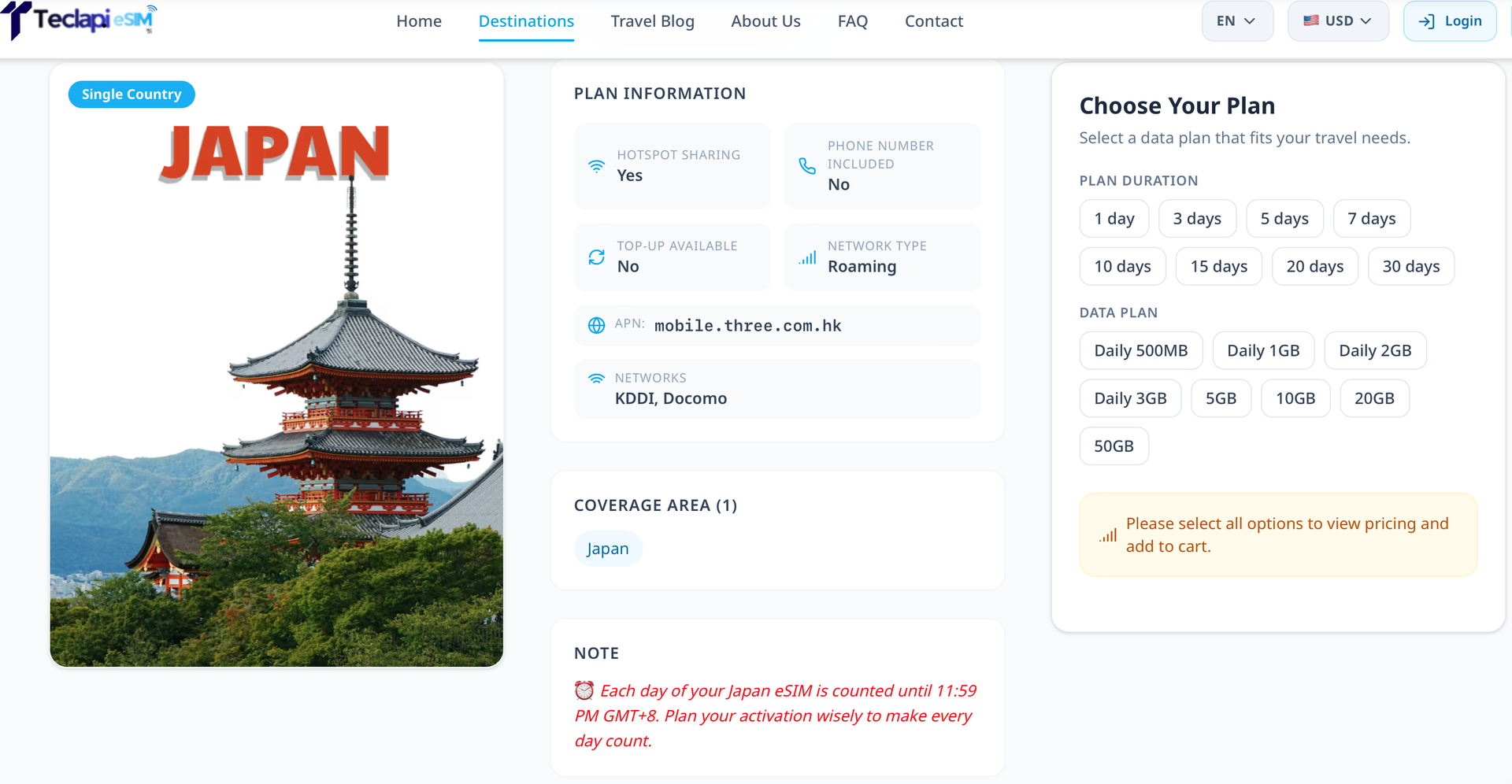
Japan is the kind of destination where your eSIM should feel invisible. It should quietly keep you connected while you focus on the real questions, like which train exit to take, whether the ramen shop takes cash only, and how you accidentally walked into the best convenience store meal of your life.
Teclapi eSIM for Japan is built for travelers who want reliable travel data without making connectivity the main event of the trip.
- Made for real Japan itineraries. Most travelers do not stay in one place. You may go from Tokyo to Kyoto, Osaka to Nara, Hakone to Mount Fuji, or Sapporo to ski towns. Teclapi Japan eSIM connects through KDDI and Docomo, giving you access to two major Japanese networks across key travel areas.
- Useful for city travel and beyond. In Japan, strong data is not only about big cities. It helps when you are moving through train stations, checking Shinkansen routes, finding a ryokan, translating a menu, or navigating smaller streets where the destination is technically “nearby” but somehow still impossible to see.
- Flexible plans from just $1.43. Not every Japan trip needs the same data package. Teclapi offers daily plans, total data plans, and unlimited options, so you can choose based on your trip length, travel style, and how much you use your phone.
- Daily, total, and unlimited data options. Light travelers can keep things simple with smaller plans. Standard travelers can choose balanced data packages for maps, translation, and social media. Heavy users, remote workers, and hotspot sharers can look at larger or unlimited-style options for more freedom.
- No contracts, no hidden fees. You are buying travel data for your trip, not signing up for a long-term mobile plan. There is no local paperwork, no SIM kiosk negotiation, and no surprise roaming-style daily charges.
- Instant delivery and simple setup. Buy online, receive your eSIM details, install it before your flight, and arrive in Japan with data ready to go. That first moment of opening your map at the airport should feel easy.
- Keep your home number active. Teclapi Japan eSIM is data-focused, so you can keep your regular SIM active for calls, texts, banking OTPs, or important messages while using Teclapi for travel data.
- Helpful for Asia trips, not just Japan. If your Japan trip is part of a bigger Asia route — maybe South Korea, Vietnam, Thailand, Singapore, or Taiwan — Teclapi’s wider Asia coverage can make it easier to plan connectivity across multiple destinations.
For travelers who want an affordable, flexible, and practical Japan eSIM, Teclapi keeps the setup simple and the experience travel-friendly. Choose your plan before you fly, install it at home, and land with one less thing to figure out.
So, What Is the Best eSIM for Japan Travel?
The best travel eSIM for Japan is the one that helps your trip feel easier in the moments that matter: Finding the right train platform, translating a menu, checking a hotel address, opening a QR ticket, booking a last-minute table, or navigating a quiet Kyoto side street after sunset. If you are planning a trip to Tokyo, Kyoto, Osaka, Hokkaido, Fukuoka, or a multi-city Japan itinerary, Teclapi eSIM for Japan gives you flexible data options, access to KDDI and Docomo networks, instant setup, no contracts, and affordable plans from just $1.43.
Choose your plan before departure, install it before your flight, and land in Japan with data already waiting on your phone. Less Wi-Fi hunting, more exploring.