
Why Internet Actually Matters More in the USA

World Cup traveler takeaway: If the USA trip is part of a World Cup 2026 itinerary, a USA-only eSIM may not be the most convenient choice. Many fans may travel between the United States, Canada, and Mexico, follow multiple matchdays, or change cities quickly between games. In that case, consider a dedicated World Cup 2026 eSIM so mobile data is ready for match tickets, stadium entry, rideshare pickup, live maps, group chats, and last-minute travel changes across the tournament route.
The USA does not always feel like one travel destination. It feels like many different trips stitched together: A subway trip in New York, a rideshare ride in Los Angeles, a theme park day in Orlando, a conference in Las Vegas, a road trip through Arizona, and maybe a national park where “five minutes away” can still mean no service for a while.
That is why mobile data matters more than many travelers expect.
- Airport arrival often starts with an app. In airports like LAX, JFK, SFO, MIA, LAS, and MCO, travelers usually need data for terminal maps, hotel addresses, rideshare pickup zones, flight updates, airport shuttles, and family messages. Free airport Wi-Fi may help, but it is not something to depend on when everyone around the baggage belt is trying to connect at the same time.
- Rideshare is part of the travel system. In many American cities, Uber, Lyft, taxis, hotel shuttles, and rental car pickups are not in the same place. At LAX, for example, travelers often need to follow signs or take a shuttle to the LAX-it pickup area for ride apps and taxis. Without data, even finding the correct pickup point can feel like a small airport puzzle.
- Public transport is very city-specific. New York is different from Chicago, Washington D.C. is different from San Francisco, and Los Angeles is a different world entirely. Some cities are train-friendly, some are bus-heavy, and some quietly assume visitors will use a car. Mobile data helps with route changes, tap-to-pay transit, walking directions, and real-time service alerts.
- Cashless and app-based travel is normal. Many travelers use digital wallets, mobile tickets, restaurant reservations, parking apps, stadium apps, food delivery, ride-hailing, and hotel check-in links. A disconnected phone can turn simple tasks into unnecessary friction.
- USA distances are bigger than they look. A day trip from Las Vegas to the Grand Canyon, a California coast drive, or a national park route can involve long stretches where planning ahead matters. Mobile data is useful for navigation, but smart travelers also download offline maps before remote routes.
- Events can overload the normal rhythm of a city. Concerts, sports games, conferences, college graduations, Thanksgiving, Christmas, summer holidays, and spring break can make airports, hotels, roads, and transport hubs busier than expected.
A USA eSIM is less about “being online all the time” and more about removing small travel problems before they become expensive or stressful. It keeps the trip moving when the plan changes, the pickup location moves, or the hotel Wi-Fi is still one check-in code away.
Why Travelers Use eSIM for USA Instead of Other Options

Travelers have several ways to get internet in the United States, but the best option depends on how the trip actually moves. A short business trip, a family theme park holiday, a New York city break, and a West Coast road trip do not need the same setup.
| Option | Pros | Cons | Useful case for tourists | Estimated price |
| International roaming |
|
| Best for very short trips, business travelers, or tourists who only need light data for 1–2 days. | Around $5–$15/day, depending on the home carrier and roaming pass. |
| Physical SIM card |
|
| Useful for students, long-stay visitors, or travelers who specifically need a US phone number. | Around $15–$60/month for carrier-direct prepaid plans, depending on data and network. |
| Pocket Wi-Fi |
|
| Useful for families or groups staying together most of the day, especially if several devices need Wi-Fi. | Around $10–$16/day, often plus shipping, deposit, or return fees. |
| Public Wi-Fi |
|
| Useful as a backup for hotel browsing, laptop work, or saving mobile data at cafés. | Usually free, but availability and quality vary. |
| USA eSIM |
|
| Best for most tourists, city travelers, road trippers, event travelers, and anyone who wants maps, rideshare, bookings, and messaging ready on arrival. | Around $4–$75, depending on data amount, duration, and whether the plan is fixed-data or unlimited-style. |
For most visitors, a USA eSIM is the most balanced choice because it fits the real arrival flow: Install before flying, land connected, call a rideshare, open maps, message the hotel, and avoid searching for a SIM store after a long flight.
Traveler Tips: Many USA travel eSIMs are data-only. That is fine for WhatsApp, iMessage, Messenger, Google Maps, Uber, Lyft, email, browsing, and mobile tickets, but it is not the same as having a US phone number for normal calls or SMS. Check the plan details before ordering.
What to Look for in a USA eSIM Plan
eSIM Important Note: Many recent iPhone, Samsung Galaxy, and Google Pixel models support eSIM, but compatibility can vary by model, country version, and carrier lock. A quick check before checkout is much better than discovering the problem after receiving the QR code.
Choosing a USA eSIM should start with the trip, not the price. A weekend in Manhattan, a Disney family trip, a Las Vegas conference, and a 3-week road trip through the West Coast all use mobile data differently.
1. Network Access: AT&T, T-Mobile, and Verizon
The USA has three major mobile networks: AT&T, T-Mobile, and Verizon. All offer strong coverage, but the best experience depends on where travelers go — city centers, airports, suburbs, highways, stadiums, or national parks.
| Network | Coverage | Speed | Price range | Practical traveler view |
| T-Mobile |
| Around 274.4 Mbps median download, one of the strongest speed results in recent Speedtest-based reports. | Around $15–$60/month for carrier-direct prepaid plans, depending on data, unlimited access, and AutoPay. | Best for city-heavy trips, fast browsing, maps, rideshare, social apps, video calls, and hotspot in major destinations. |
| AT&T |
| Around 129.3 Mbps median download, enough for maps, messaging, booking apps, mobile tickets, video calls, and daily browsing. | Around $20–$60/month for carrier-direct prepaid plans, depending on annual prepayment, data speed, hotspot, and unlimited tier. | A practical choice for travelers moving between cities, suburbs, hotels, airports, and business areas. |
| Verizon |
| Around 133.9 Mbps median download, with a strong reputation for reliability and broad network performance. | Around $35–$60/month for carrier-direct prepaid plans with AutoPay. | Good for road trips, suburbs, and coverage-focused travel, but not every travel eSIM includes Verizon access. |
For most visitors, a USA eSIM that runs on AT&T and T-Mobile is a practical fit. T-Mobile adds strong speed in many city routes, while AT&T gives travelers broad everyday coverage across airports, hotels, suburbs, and common tourist areas.
Still, no network works perfectly everywhere. Signal can weaken indoors, underground, in stadiums, remote highways, deserts, mountains, and national parks. For road trips or park visits, download offline maps before leaving the city.
2. Data Plan: Match It to How the Trip Feels
A USA trip can quietly use a lot of data because travelers rely on their phones for almost every decision: where to eat, how to get there, how long the line is, which gate changed, where the rideshare driver stopped, or whether the hotel will accept early check-in.
| Traveler type | Typical USA data behavior | Suggested Teclapi USA eSIM plan |
| Light city traveler | Maps, messaging, email, search, hotel Wi-Fi at night | Daily 500MB for very light use, or Daily 1GB for a safer city-trip setup |
| Standard tourist | Google Maps, rideshare, social media, mobile tickets, restaurant search | Daily 1GB or Daily 2GB for steady daily usage across airports, hotels, and city travel |
| Theme park or event traveler | Mobile tickets, group messages, wait-time apps, photo uploads, rideshare | Daily 2GB or Daily 3GB, especially for Orlando, Las Vegas, concerts, sports games, or conferences |
| Road trip traveler | Navigation, weather, roadside search, hotel changes, music, route checks | 10GB, 15GB, 20GB, or 30GB total data, depending on trip length; download offline maps before remote routes |
| Remote worker | Hotspot, email, Slack/Teams, Google Drive, light video calls | 30GB, 50GB, or Unlimited, depending on laptop hotspot and meeting usage |
| Heavy social user | Reels, TikTok, video upload, cloud backup, streaming | 50GB or Unlimited, especially for longer trips or daily video-heavy usage |
For short city breaks, a Daily 1GB or Daily 2GB plan is usually easier to manage. For road trips or multi-city travel, a larger total data plan such as 15GB, 20GB, or 30GB gives more flexibility because some days will use much more data than others. For remote work, hotspot sharing, or heavy video usage, 50GB or Unlimited is the safer direction.
3. Hotspot Sharing
Hotspot matters in the USA because many travelers carry more than one device. A laptop for work, a tablet for kids, a second phone for photos, or a travel partner with no data can all turn hotspot into a real trip-saver.
Before buying a USA eSIM, check whether hotspot/tethering is supported. This is especially important for business trips, road trips, digital nomads, and families.
Why Choose Teclapi eSIM for USA
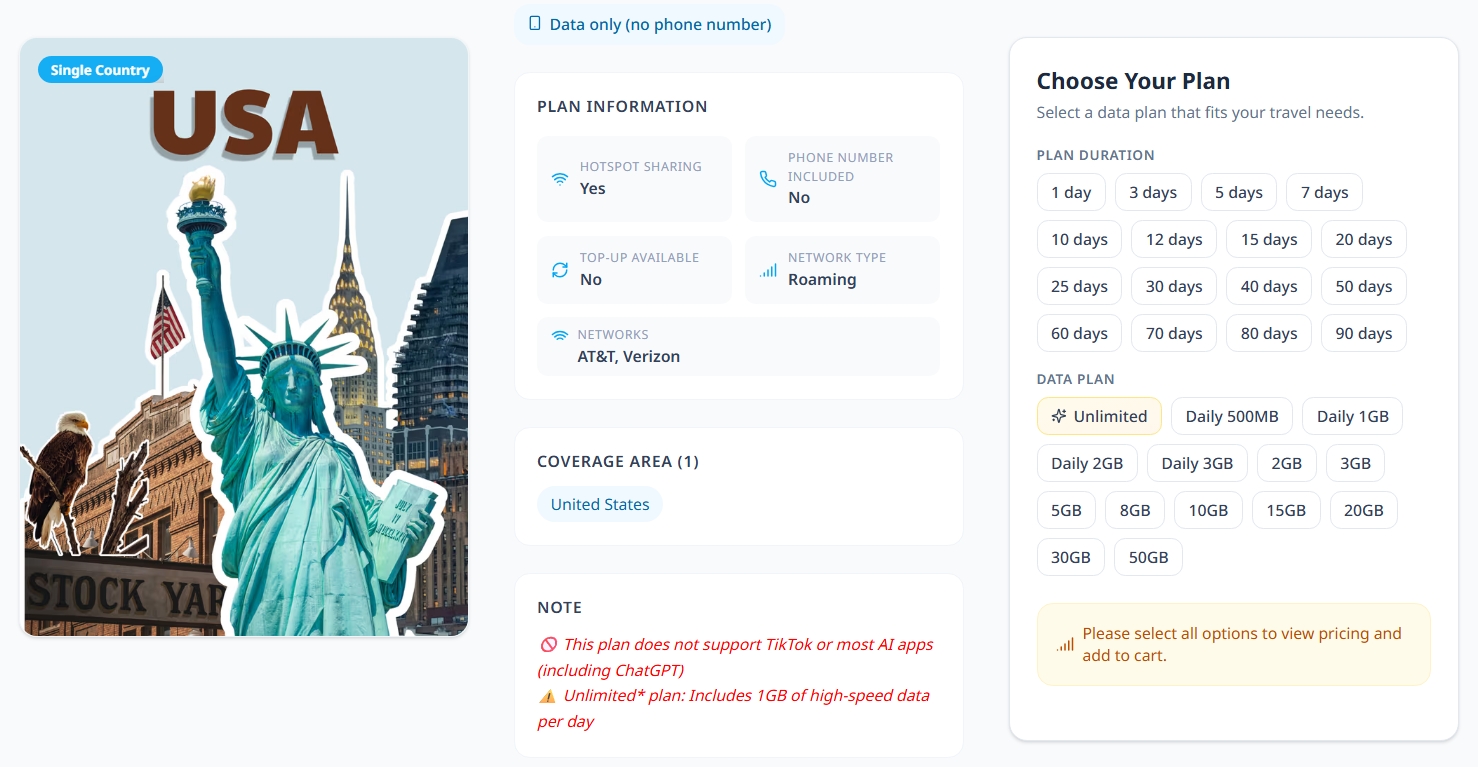
A good USA eSIM should feel like something prepared before the trip, not another problem to solve after landing. Teclapi eSIM for USA is built for travelers who want a simple setup, flexible data, and reliable network access for the everyday moments that make or break a USA itinerary.
- Runs on AT&T and T-Mobile networks: Teclapi USA eSIM connects through two major US networks, making it practical for common travel routes, major cities, airports, business trips, and tourist destinations.
- Plans from just $1.85: Travelers can start small for short trips or choose a larger option for longer stays without committing to a local carrier contract.
- Flexible 1–30 day options: A weekend in New York, a week in California, or a longer multi-city itinerary can be matched more closely to the actual travel plan.
- Daily, Total, and Unlimited plan styles: Light users, normal tourists, heavy app users, and remote workers can choose based on how they actually use data.
- QR code sent by email after payment: Install before flying, while Wi-Fi is stable and there is no airport pressure.
- No physical SIM swap: Keep the home SIM active for banking OTPs, WhatsApp, iMessage, and important contacts where supported by the device and home carrier.
- No contracts, no hidden fees: Teclapi is designed for travel connectivity, not a long-term US carrier plan.
- Support through familiar channels: Teclapi supports travelers via WhatsApp, Zalo, Facebook, and email, which is useful when setup questions happen outside a neat travel schedule.
Teclapi is a strong option for travelers who want a USA eSIM that is easy to prepare before departure and practical for real travel use: airport pickup, maps, rideshare, hotel check-in, mobile tickets, browsing, messaging, and hotspot sharing.

Conclusion
A USA trip usually moves through apps, airport directions, rideshare pickup, transit taps, hotel messages, mobile tickets, restaurant bookings, weather alerts, and road-trip navigation. A reliable USA eSIM keeps those small travel moments from turning into delays. For travelers who want flexible data, AT&T and T-Mobile network access, QR code delivery by email, and no physical SIM swap, Teclapi eSIM for USA is a practical way to arrive prepared and stay connected across the journey.