
China Mobile vs China Unicom vs China Telecom: Which One Should Tourists Choose?

If pressed for a single answer, China Mobile tends to edge ahead for travelers whose trip stretches beyond the big cities, purely on the strength of its coverage map. That said, calling it the automatic winner would be doing the other two carriers a disservice, since China Unicom and China Telecom often deliver a smoother experience for a typical city-based itinerary, particularly with foreign phones. The comparison below breaks down coverage, speed, and price so the choice lines up with your actual trip rather than a generic recommendation.
| China Mobile | China Unicom | China Telecom | |
| National coverage | Around 96–97% population coverage, the widest of the three, including rural provinces and mountainous terrain | 99% 4G population coverage across all 31 provincial-level regions, per China Unicom's 2025 interim results | Coverage concentrated in southern and eastern provinces (Guangdong, Fujian, Zhejiang, Jiangsu), with a comparable urban footprint to Unicom in those regions |
| Coverage in tourist areas | Strongest in remote Great Wall sections, western China, small towns, and inside subway tunnels | Solid across Beijing's core sightseeing districts, the Forbidden City area, and Tianjin | Solid across Shanghai, Guangzhou, Shenzhen, and Hangzhou |
| Speed average | Fastest reported median 4G download among the three, around 195 Mbps per Speedtest Global Index data from March 2024 | Around 143 Mbps median 4G download over the same period, still comparable to China Mobile in city testing | Generally reported slightly behind Unicom in comparative reviews, though solidly capable for everyday browsing, maps, and streaming |
| Price average | Tends to sit at the premium end — roughly ¥150–500 ($21–70) for an airport tourist SIM, with city-store plans starting closer to ¥50–100 ($7–14) | Frequently the most tourist-oriented pricing, commonly ¥200–300 ($28–42) for a 20GB/30-day airport package | Broadly similar to Unicom, sometimes running a touch higher at ¥250–350 ($35–50) for a comparable package |
| Best for | Multi-region trips, rural travel, and itineraries that go well beyond the major cities | First-time visitors and city-based trips, especially for travelers prioritizing foreign-device compatibility | Southern and coastal itineraries — Shanghai, Guangzhou, Shenzhen, and the Pearl River Delta |
Put simply, a trip built around Beijing and Shanghai sightseeing tends to run smoother on China Unicom or China Telecom, both in terms of device compatibility and price. A trip that wanders into the countryside, western China, or a long stretch of the Great Wall benefits more from China Mobile's reach, even with the higher price tag and the extra step of checking your phone's supported bands beforehand.
Where to Buy China Mobile, China Unicom, and China Telecom SIM Cards or eSIMs?
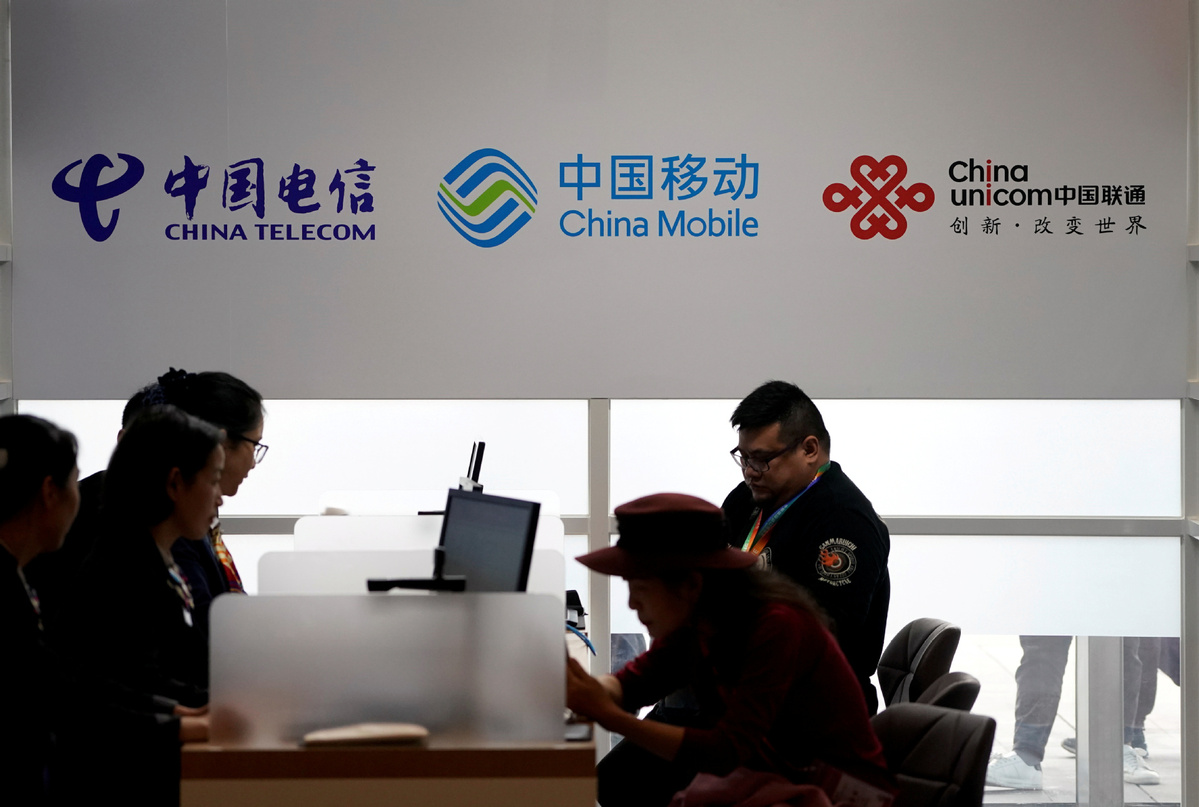
All three carriers sell tourist SIM cards at selected counters in major international airports and at official retail stores across Chinese cities. Travelers choosing an eSIM can purchase and install their plan online before departure instead. Passport registration is mandatory for physical SIM cards bought in China, while prices, opening hours and English-language support can vary considerably by location.
Beijing Capital International Airport (PEK):
China Mobile operates a service hall inside Gate 7 on the first floor of Terminal 2, as well as a counter near Baggage Carousel 38 in Terminal 3’s international arrivals area before customs.
China Unicom has a service hall in Terminal 3’s International Baggage Claim Hall. Some travel guides report longer operating hours at Terminal 2 than Terminal 3,
Late-arriving travelers should confirm the current schedule before departure rather than assume that every counter stays open overnight.
Beijing Daxing International Airport (PKX):
China Mobile has a service hall at counter S-AL03-003 inside the terminal
China Unicom operates from the east side of the international arrivals area on the first floor.
Both are convenient options for completing passport registration and activation before leaving the airport, although available tourist packages may differ from those sold at city stores.
Shanghai Pudong International Airport (PVG):
Tourist SIM kiosks operate in the arrival areas of both Terminal 1 and Terminal 2. China Unicom has been reported near Luggage Belt 28 in Terminal 2, with additional China Mobile and China Unicom services available after customs near the pocket Wi-Fi counters.
Airport packages commonly cost around CNY 150–500, depending on the included data, validity period and call allowance, so checking the full package rather than comparing price alone is worthwhile.
Shanghai Hongqiao International Airport (SHA):
China Unicom services have been reported near Luggage Belt 28 in Terminal 1’s arrival hall, with additional China Mobile and China Unicom counters nearby.
Tourist SIMs may also be available from convenience stores in the public areas, although buying from an official carrier counter is usually safer when passport registration, activation or APN support is required.
Official carrier stores in the city:
China Mobile, China Unicom and China Telecom all operate branded service halls throughout major cities.
City stores often offer lower prices or a wider selection than airport counters, but not every branch is experienced in registering foreign passports or assisting in English.
Travelers should visit a directly operated service hall, ask specifically for a short-term nationwide data plan and confirm that the package is not limited to the province where it was purchased.
Online before departure:
International travel eSIM providers allow travelers to purchase and install a plan from home, avoiding passport registration, airport queues and uncertainty around counter opening hours. A suitably routed China travel eSIM may also provide access to international services that remain restricted through a standard mainland SIM, which makes the difference between local SIMs and travel eSIMs especially important in China.
The Great Firewall: Why Your Carrier Choice Matters
China operates one of the most extensive internet filtering systems in the world, generally known as the Great Firewall, and it applies to any connection running through a domestic Chinese carrier — regardless of which of the three you pick. This is the detail that trips up a lot of first-time visitors, because the carrier choice above only solves half the problem. Signal strength gets you online; it does nothing about which sites and apps you're actually allowed to reach.
Commonly blocked services include:
- Google's entire suite — Search, Maps, Gmail, Drive, Photos, YouTube
- Social media — Instagram, Facebook, X (Twitter), Snapchat, Reddit, Pinterest
- Messaging apps — WhatsApp, Telegram, Signal, Facebook Messenger
- International news outlets — BBC, The New York Times, CNN, The Guardian
- Streaming and productivity tools — Netflix, Spotify, Dropbox, and many VPN services themselves
For years, the go-to workaround was installing a VPN, and that still works for some travelers, though with caveats worth knowing before you rely on one. VPN performance inside China is inconsistent — speeds can crawl during peak hours, connections drop without warning, and certain VPN providers get blocked outright during politically sensitive periods. The bigger trap is timing: if you didn't set up a VPN before you landed, you may not be able to reach the app store or the VPN provider's own website to download one once you're already behind the firewall.
A few practical habits help regardless of which route you take. Install and test any VPN while you're still on home Wi-Fi, days before departure, not at the gate. Keep a backup VPN provider in mind in case your first choice gets blocked mid-trip. And if messaging apps are non-negotiable for staying in touch with people back home, consider a travel eSIM that routes data internationally instead of through a domestic Chinese network, since that sidesteps the filtering at the source rather than trying to tunnel around it afterward — the next section walks through exactly how that comparison plays out.
Local SIM vs Travel eSIM for China: What Actually Solves the Problem
Since carrier choice alone doesn't resolve the app-access question, it helps to line up the two connectivity methods side by side on the details that actually shape a trip: how quickly you're online, whether your usual apps work, and how much friction sits between you and a working connection.
| Local SIM Card | Travel eSIM | |
| Great Firewall access | Blocked by default — Google, WhatsApp, and most social apps need a separate VPN | Depends on the provider and plan; many route data internationally and can bypass some restrictions, though this isn't automatic or universal across every eSIM |
| Setup | Purchased on arrival, with passport scan and facial recognition required | Bought and installed before departure, active the moment you land |
| Where to buy | Airport counters or official carrier stores, in person | Purchased entirely online, no physical location involved |
| Language & paperwork | Chinese-language registration forms, with English support varying by location | English-language purchase and setup, completed from home |
| Time to get connected | Typically 30–60 minutes at the counter, plus any queue | Around five minutes to install, ready as soon as you land |
| Home number | Often replaced, meaning you lose your original number for the trip | Usually stays active for calls, texts, and OTP codes, since most travel eSIMs are data-only |
A local SIM can occasionally undercut an eSIM on raw price, but it hands you two separate problems to manage: the arrival-day scramble of finding a counter and getting through registration, and the ongoing uncertainty of whether your everyday apps will actually load. A well-matched travel eSIM tends to remove both at once — you're online before you land, and depending on the plan, your messaging and social apps may work without a VPN in the mix at all. One thing worth checking before you buy either option: your phone needs to be carrier-unlocked and eSIM-compatible for a travel eSIM to work, so it's worth a quick look at your device model against a provider's compatibility list rather than assuming.
Where Does Teclapi’s China eSIM Fit In?
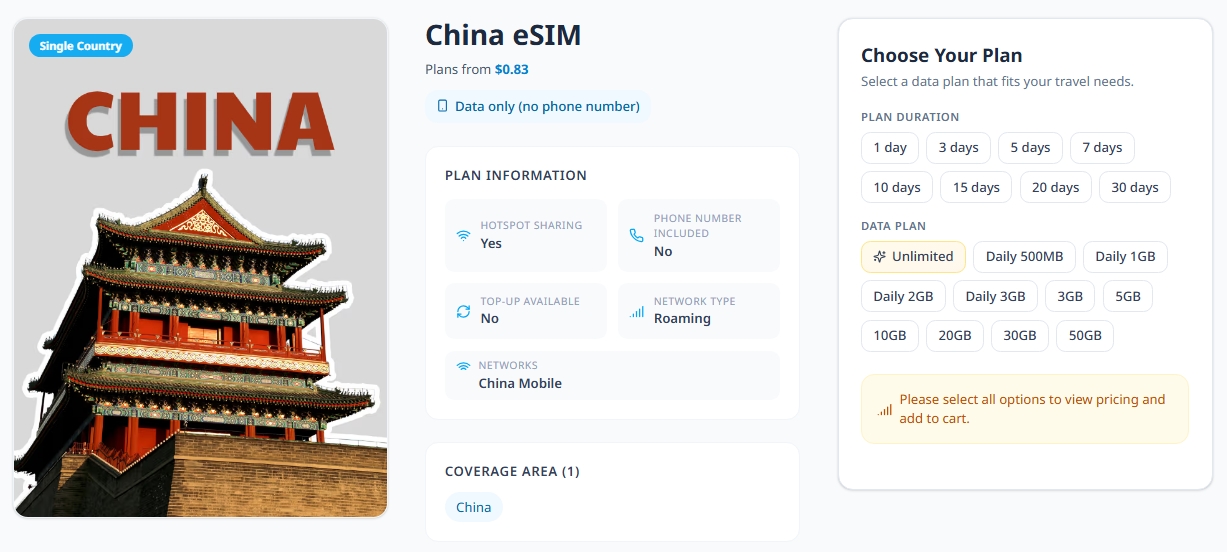
Landing in China is much easier when the first task is finding the airport exit, not finding a telecom counter. Teclapi’s China eSIM is built for travelers who want the broad network reach of China Mobile but prefer to arrange their connection before the journey begins.
Instead of replacing a local SIM feature for feature, Teclapi focuses on the parts that matter most during a short trip: getting online quickly, staying connected across a changing itinerary and keeping essential travel apps within reach.
- China Mobile coverage beyond the city centre: The eSIM connects through China Mobile, the strongest all-round carrier in this comparison. That makes it suitable for Beijing and Shanghai city breaks, as well as multi-city routes, high-speed rail journeys and trips that continue into smaller destinations.
- A connection prepared before arrival: The QR code is delivered by email after payment, allowing the eSIM to be installed before departure and enabled for mobile data after landing. There is no passport registration, physical SIM swap or need to search for an open carrier store after a long flight.
- Plans that follow the itinerary: Prices start from $0.83, with options covering trips from one to 30 days. Travelers can choose between Daily, Total and Unlimited plans depending on whether they need light everyday data, a fixed allowance for the full trip or more freedom for heavier use. There are no contracts or hidden fees added to the plan.
- Built around the apps used during a China trip: The connection supports essential local services such as WeChat, Alipay, Didi and Baidu Maps, together with listed international apps including WhatsApp, Telegram, Gmail and Messenger. This helps keep payments, navigation, transport bookings and communication working through one mobile connection.
- One less SIM to manage across Asia: China is often one part of a wider regional itinerary. Teclapi also provides eSIM coverage across Asia, making it easier to arrange connectivity for several destinations without repeating the local SIM process in every country.
The home SIM can remain in the phone for calls, SMS and OTP messages, while the Teclapi eSIM handles mobile data. Hotspot sharing is also supported, which is useful when a laptop, tablet or travel companion needs a connection along the way.

Final Thoughts
None of this requires turning into a telecom expert before you land. It mostly comes down to matching the carrier to your actual route — remote and rural leans China Mobile, city-focused leans Unicom or Telecom — and checking, plan by plan, whether your chosen connectivity option actually gets you past the Great Firewall for the apps you'll genuinely use. Getting that sorted before departure, rather than scrambling for it at an airport counter, tends to be the single biggest difference between a trip where the internet just works and one spent troubleshooting it from a hotel lobby.